

The dashboard said our AI was working.
We rebuilt it anyway.
A busy system can still leave a buyer cold. How operators can build buyer progress into the decisions their AI makes.
Read the essay By Maddie Bell
Founder of Synapsa

All the writing.
Essays, ideas, and practical guides.No articles match. Try another phrase or clear the filters.

Is AI Cold Calling Legal? And What Works Better for B2B
In the US, an AI voice can't cold-call a mobile or residential number to sell without prior express written consent. Here is what that rule covers, why buyers don't want those calls anyway, and a six-step plan: signal-timed calls a person makes with an AI-prepared brief, and AI voice for the calls buyers ask for.
Read the article
Personalize the Offer, Not the Opening Line: Cold Outreach That Gets Replies
A seven-step cold outreach playbook for B2B teams using AI: choose who to contact by behavior, build a ladder of offers that starts with something useful, cap your touches, answer every reply and click, and keep LinkedIn in human hands.
Read the article
Conference Follow-Up Emails That Turn Scans Into Meetings
A 48-hour plan and seven copy-ready conference follow-up emails for B2B teams. Debrief by voice each night, let AI turn the transcript into a follow-up list and drafts, and send every person you met something that proves you remember the conversation.
Read the article
Revive Old Leads by Picking Up Where They Left Off
Old leads aren't one cold pool. Sort them into five kinds of quiet, remove who shouldn't hear from you, re-check who they are now, and send the email that fits what each buyer told you last time, with seven copy-ready templates.
Read the article
The Follow-Up Email After a Sales Call Should Sound Like the Call
Eight follow-up emails built from one sample sales call, each quoting what the buyer said and setting a dated next step. Then the team standard that makes every call's notes usable by whoever comes next: classify, tag, retrieve.
Read the article
Give Every Page a Next Step: How B2B Websites Convert More Visitors
A B2B website converts more when every page offers a next step that fits the buyer on it, and one shared core behind every page answers, qualifies and routes. The door map, nine steps in the order of your biggest leak, the pricing page, and how to measure it door by door.
Read the article
Qualify Sales Leads While You Answer Them, Not a Week Later
Qualify sales leads inside the first useful reply, not on a discovery call a week later: name the few facts that decide where a lead goes, map every answer to one of four tiers with a next step, and let a person make the calls that need judgement.
Read the article
From Ad Click to Qualified Meeting: Landing Pages That Match the Ad
The whole paid funnel in 11 steps: one brand source, a landing page per ICP that repeats the ad's promise, an on-page conversation that knows the campaign, qualifying by plain-language description, and a seller prepared before the meeting.
Read the article
Lead Follow-Up: A Cadence for Every Lead Type, Built on What They Said
A follow-up cadence for six kinds of inbound lead: how many touches, how far apart, when to switch channel and when to stop, with every touch written from what the buyer said or did.
Read the article
The Top Reason Buyers Miss a Sales Call Is That They Got Busy. Remind Them Well.
Nine copy-ready emails and texts for sales meetings, in the order you send them: a confirmation that names the buyer's goal, two reminders that carry something useful, a one-reply reschedule, and a blame-free recovery after a miss. Plus how to measure meetings held per meeting booked.
Read the article
Find Everyone Who Decides Before the Deal Stalls
A seven-step method for multi-threading a deal: map the buying committee from research before the deal, add everyone buyers name in calls, introduce yourself to each person with something useful, and answer every concern inside one story the whole group sees.
Read the article
Start Onboarding From What the Buyer Already Told You
A sales to customer success handoff playbook: make closed won switch the playbook, carry what the buyer said into a note the AE approves, define activation as three milestones in the customer's terms, and match new releases to the accounts that have the gap.
Read the article
Follow Up on What They Watched, Not With the Recording
Seven copy-ready webinar follow-up emails, one for each way people engaged: stayed for all of it, asked a question, left early, missed it, or watched the replay, plus a guide download and the earned ask. Each names what the person did and offers the next useful thing instead of a demo.
Read the article
Make anonymous visits actionable
Website visitor identification tells you which companies, and sometimes which people, read your site without filling in a form. This playbook covers how it works and how to choose a tool, then what to do with each match: a conversation while they're there, a value-first note after they leave, retargeting from what they read, and the account owner brought in at named moments.
Read the article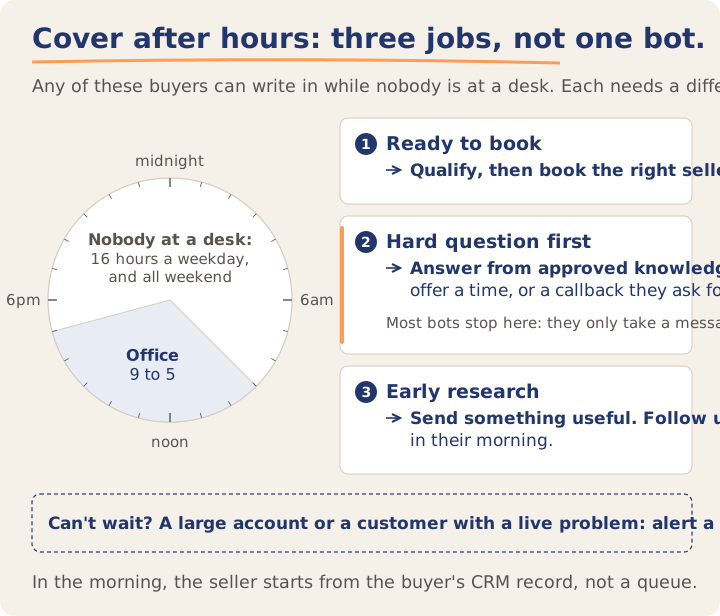
The Buyer Who Fills In Your Form at 10pm Shouldn't Wait for Monday
Your best leads often write in after everyone has gone home. A six-step playbook to get one channel answering, qualifying and booking them within two weeks, and to hand the morning team a record instead of a queue.
Read the article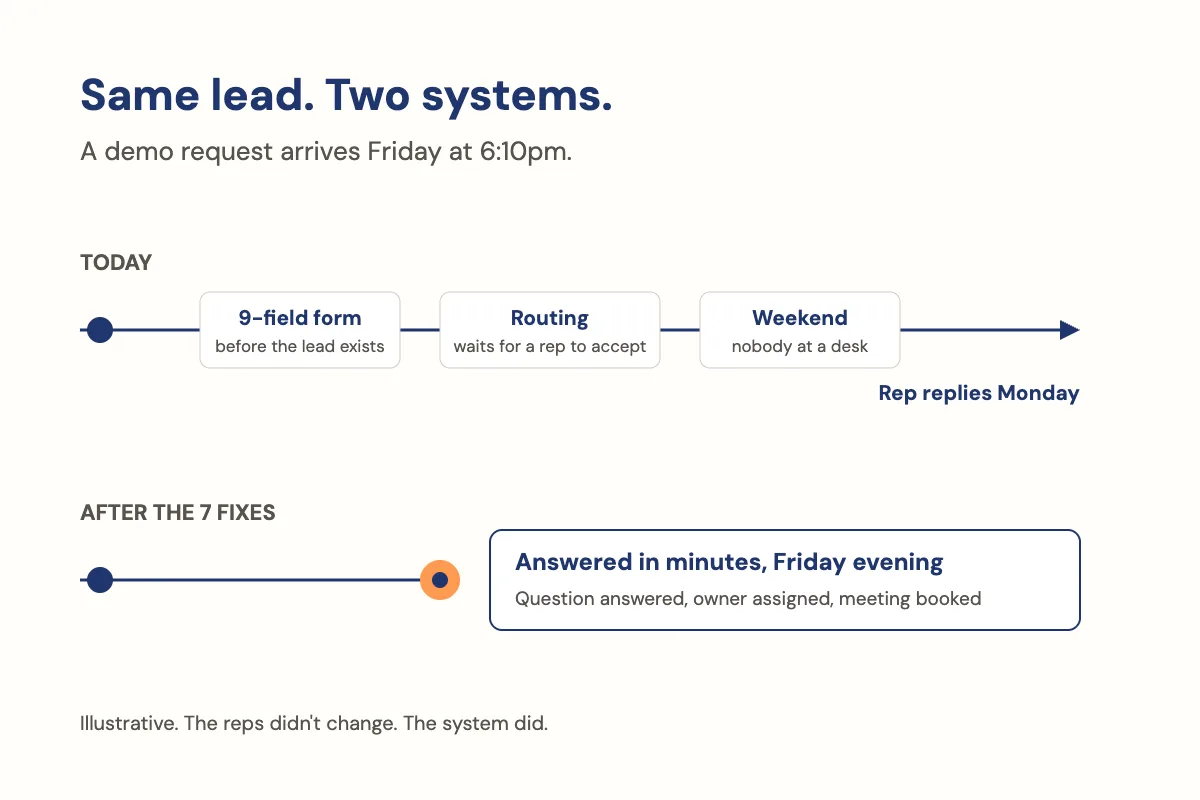
Lead Response Time Is Set by Your System, Not Your Reps: 7 Fixes
Telling the team to respond faster doesn't move lead response time, because the delay is built into the form, the routing and the hours you cover. Here are seven fixes, in order, with the owner, the check and a weekly tracker for each.
Read the article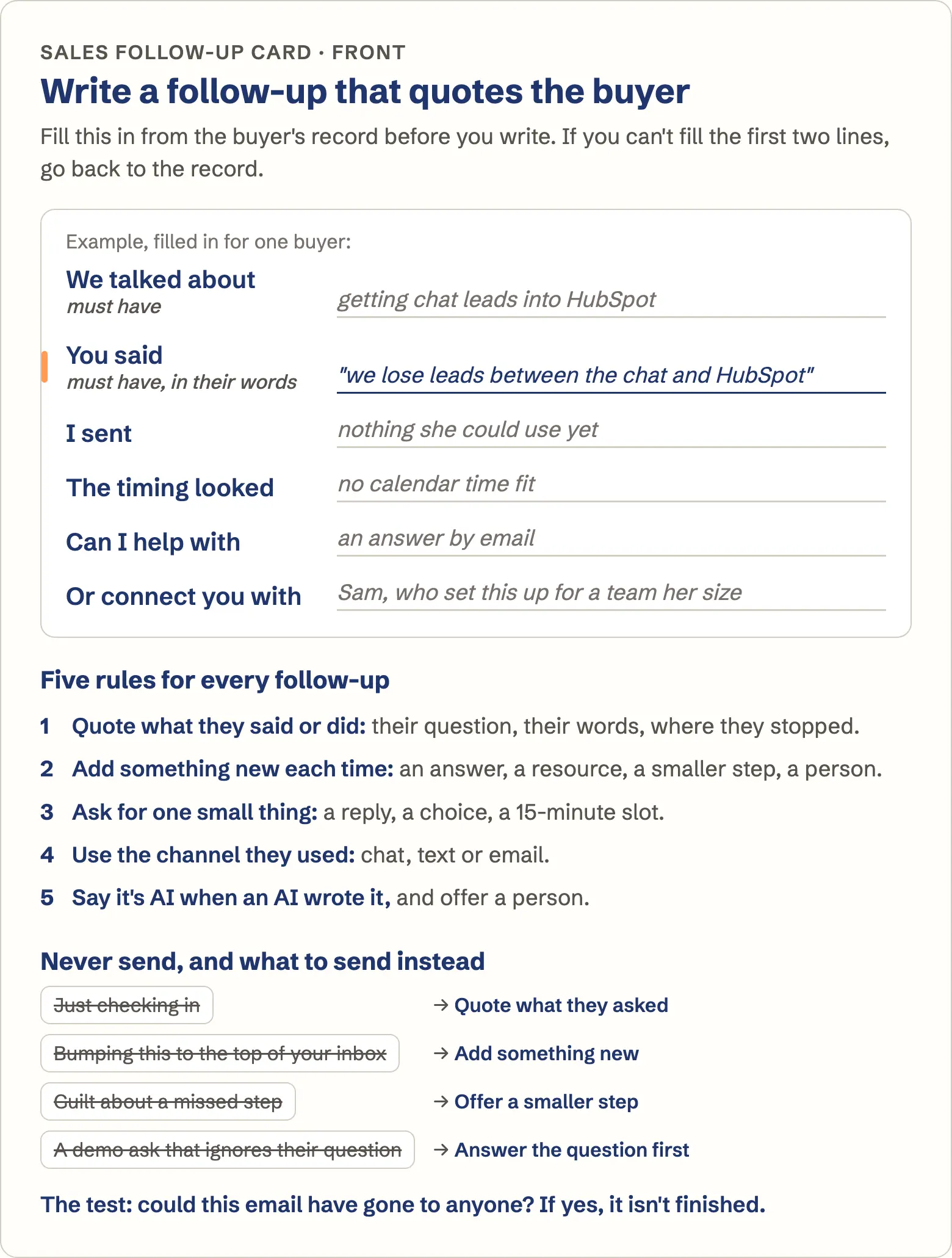
16 Sales Follow-Up Email Templates That Quote the Buyer
Sixteen copy-ready sales follow-up emails, grouped by where the buyer stopped: no reply, a half-finished form or chat, a quiet demo, or a "not yet". Each one quotes what the buyer said or did, with when to send it and when to stop.
Read the article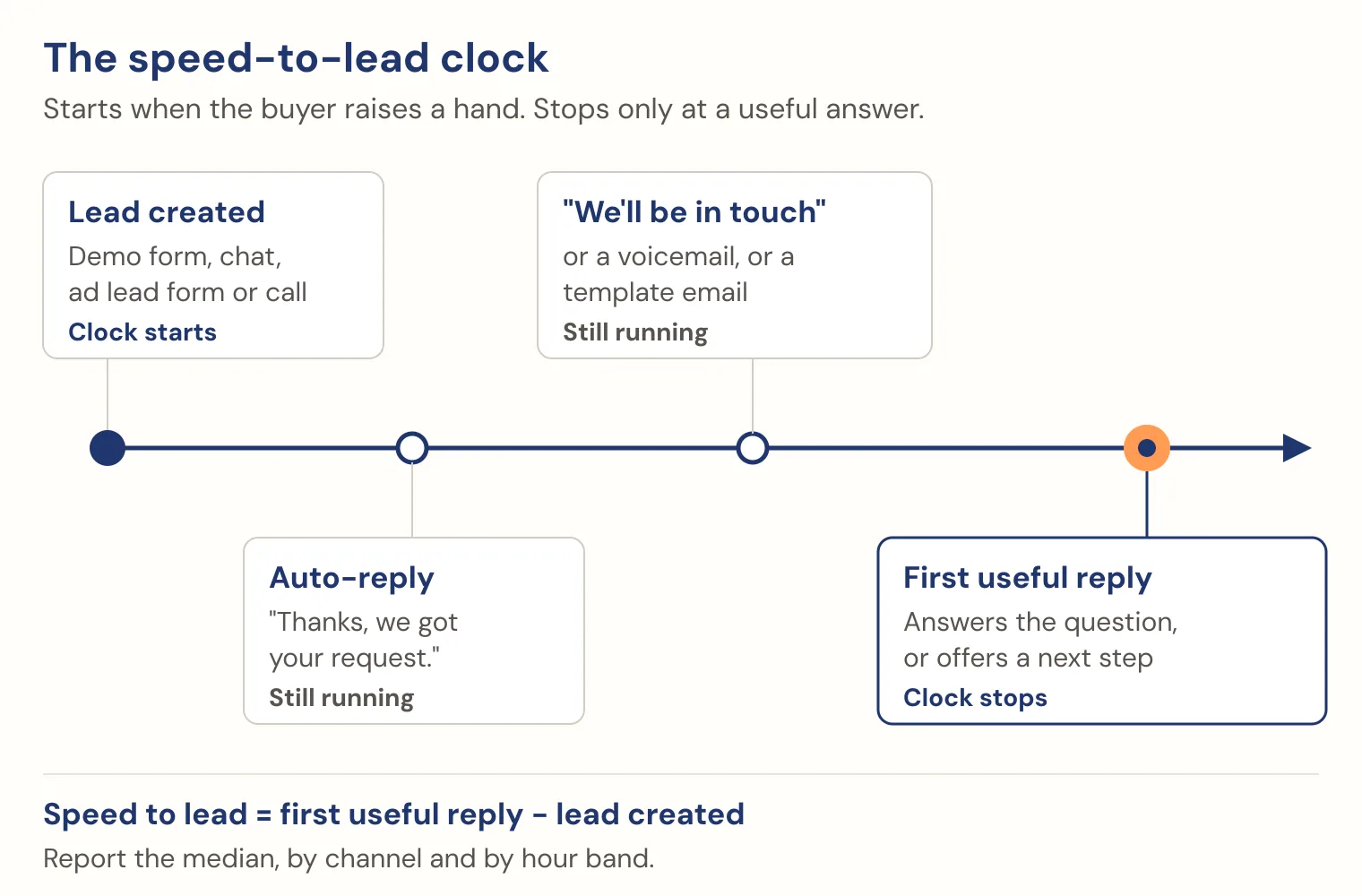
Speed to Conversation, Not Speed to First Reply: The B2B Guide to Speed to Lead
Speed to lead is the time from a buyer raising a hand to the first useful reply, not the auto-reply. How to measure it in HubSpot and Salesforce, what good looks like, and a five-day plan to fix the slowest channel first.
Read the article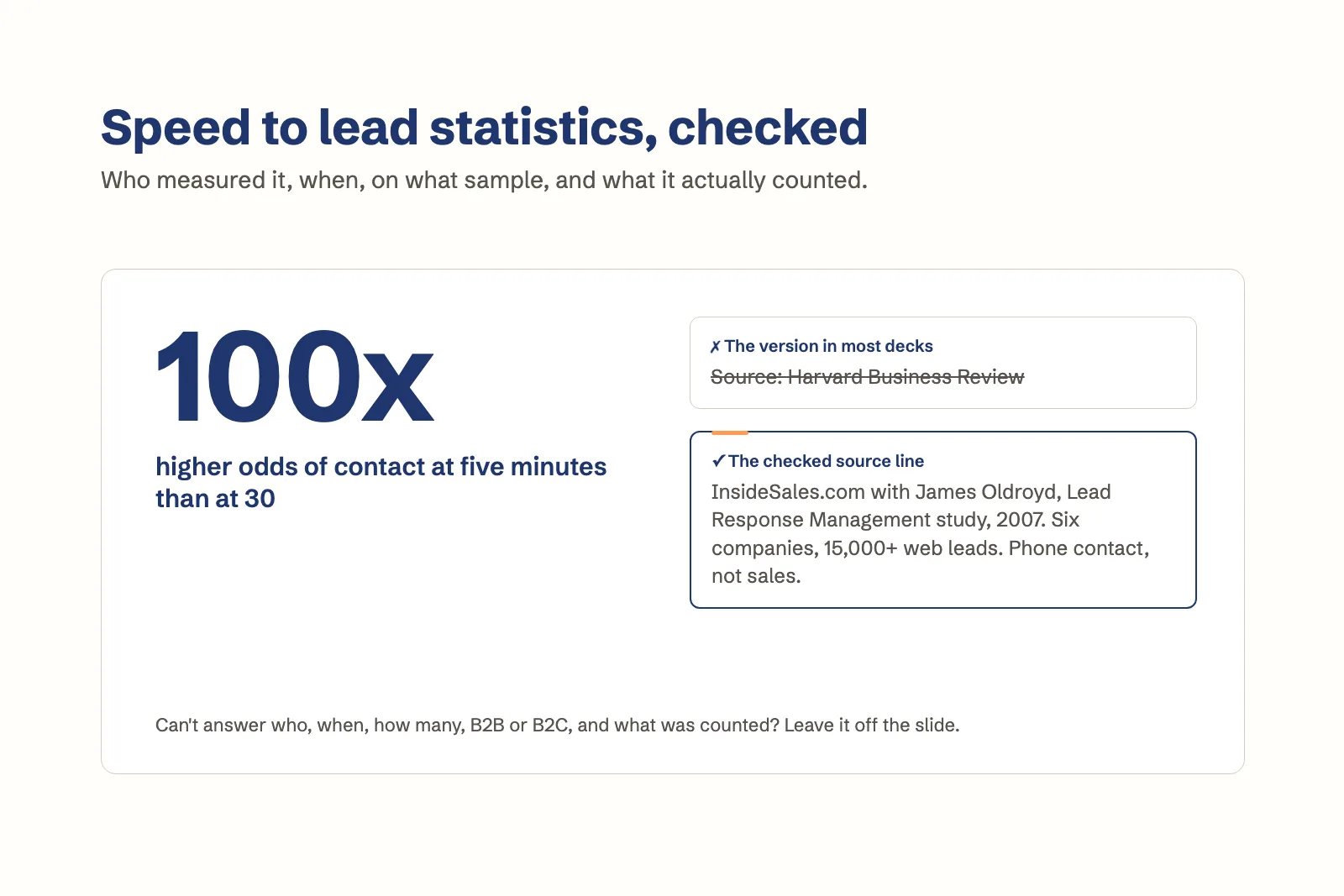
Speed to Lead Statistics: Every Study, Checked (2026)
Every speed to lead statistic traced to its study, with its sample and segment marked, and what the numbers mean now that AI can answer a lead in minutes.
Read the article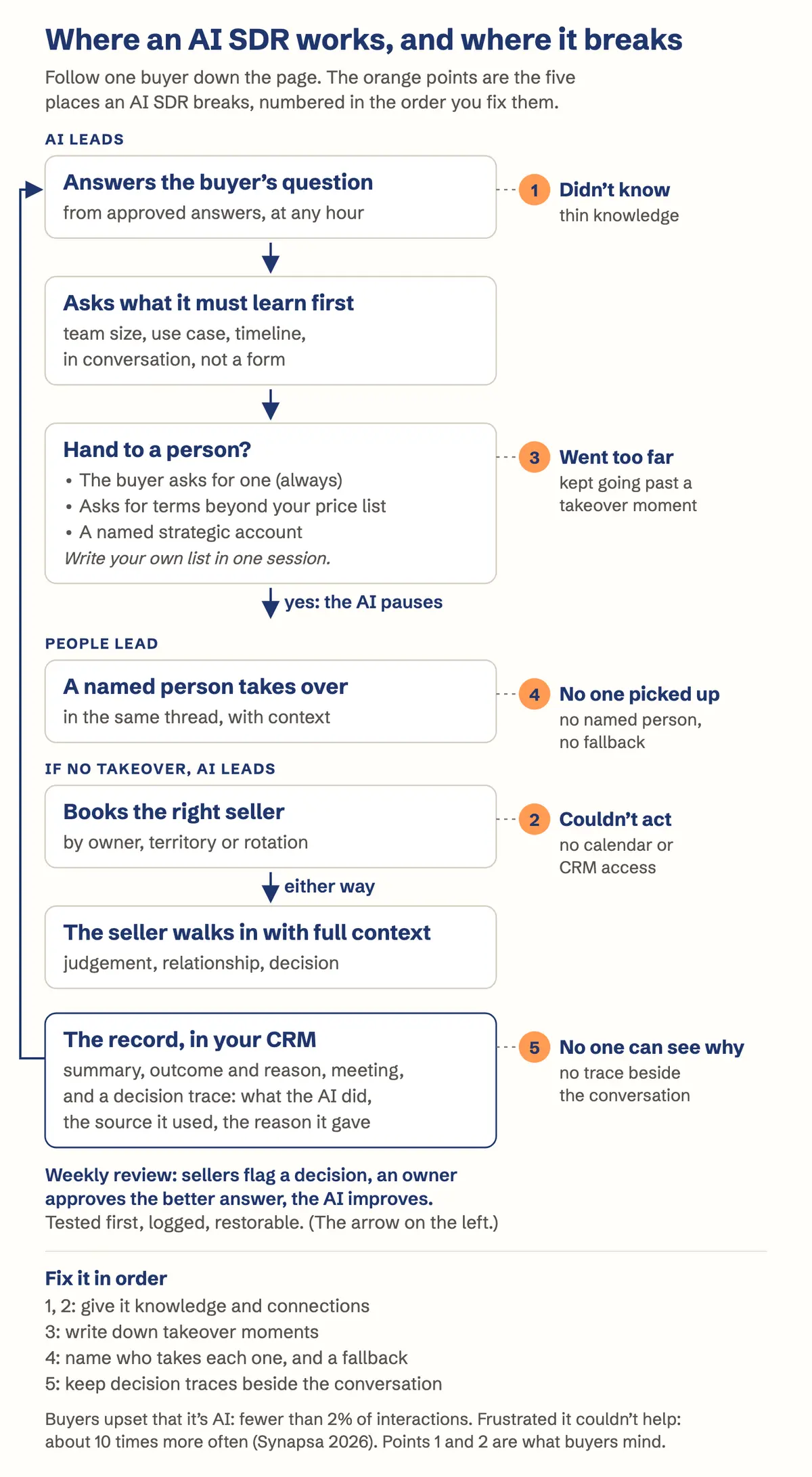
What does an AI SDR do?
An AI SDR does the sales development job, inbound and outbound. Here is where it works, where it breaks, what buyers actually mind, and the handoff agreement that decides whether its meetings hold.
Read the article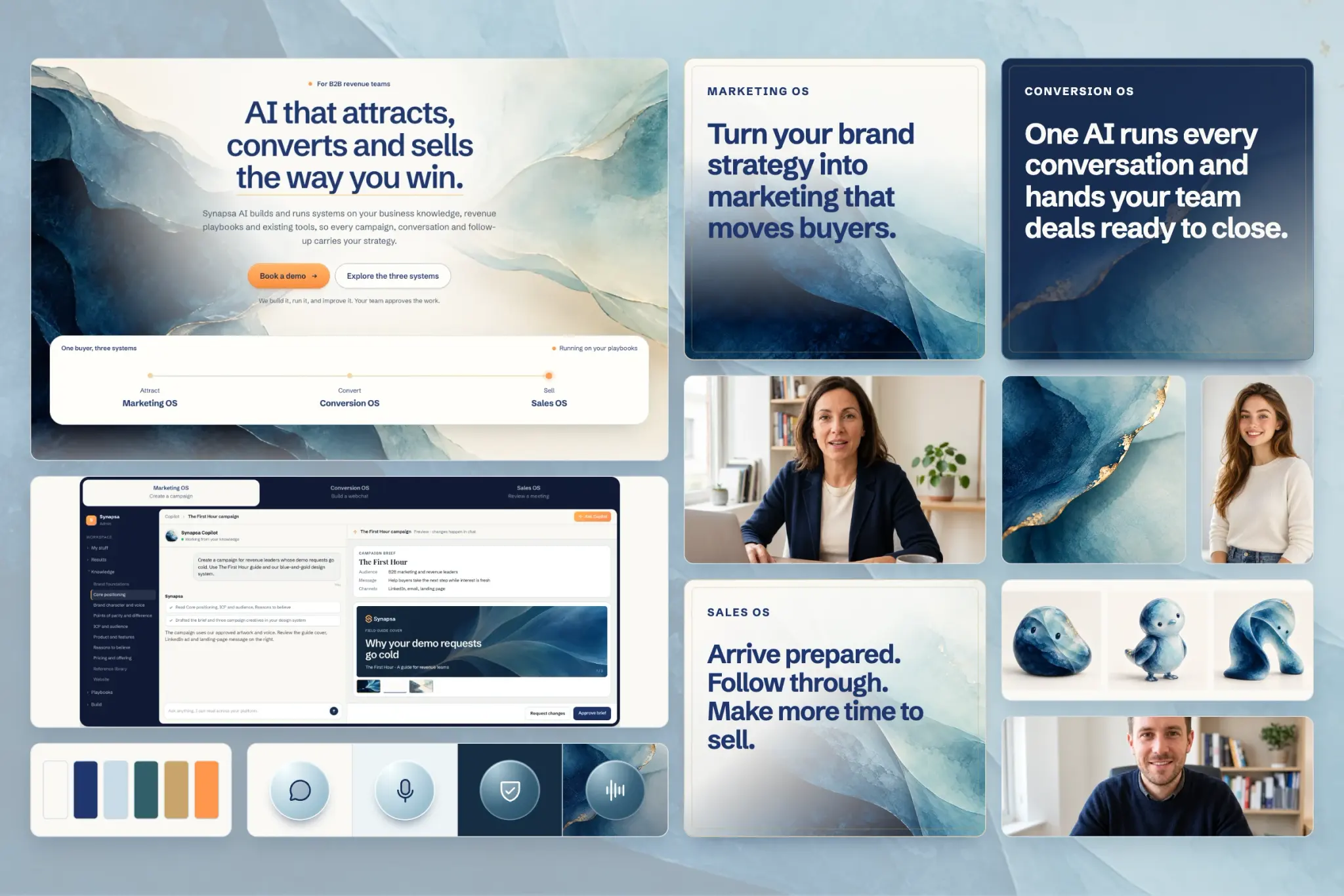
How to Build an AI Design System That Scales Your Brand
Lock the brand strategy. Pitch and choose a creative idea. Build the visual identity, prove it on a website, then scale across channels. The process, decisions and real artifacts behind Synapsa’s new system.
Read the articleThe Google Analytics Audit for B2B SaaS: 13 Steps to Analytics You Can Trust
A complete Google Analytics and Tag Manager audit for B2B SaaS: what top-performing analytics looks like, a ready measurement plan, 13 checks with what good looks like, and how to have Claude or Codex run it in your browser.
Read the articleYou Asked AI for a Draft. You Still Had to Write It.
You briefed it, corrected it, and still rewrote it. How we turn recurring voice corrections into a separate review before the next draft reaches you.
Read the article
Turn a discovery call into a proposal
Turn a discovery call into a proposal, statement of work and follow-up email ready for your review. Get the free setup guide.
Read the article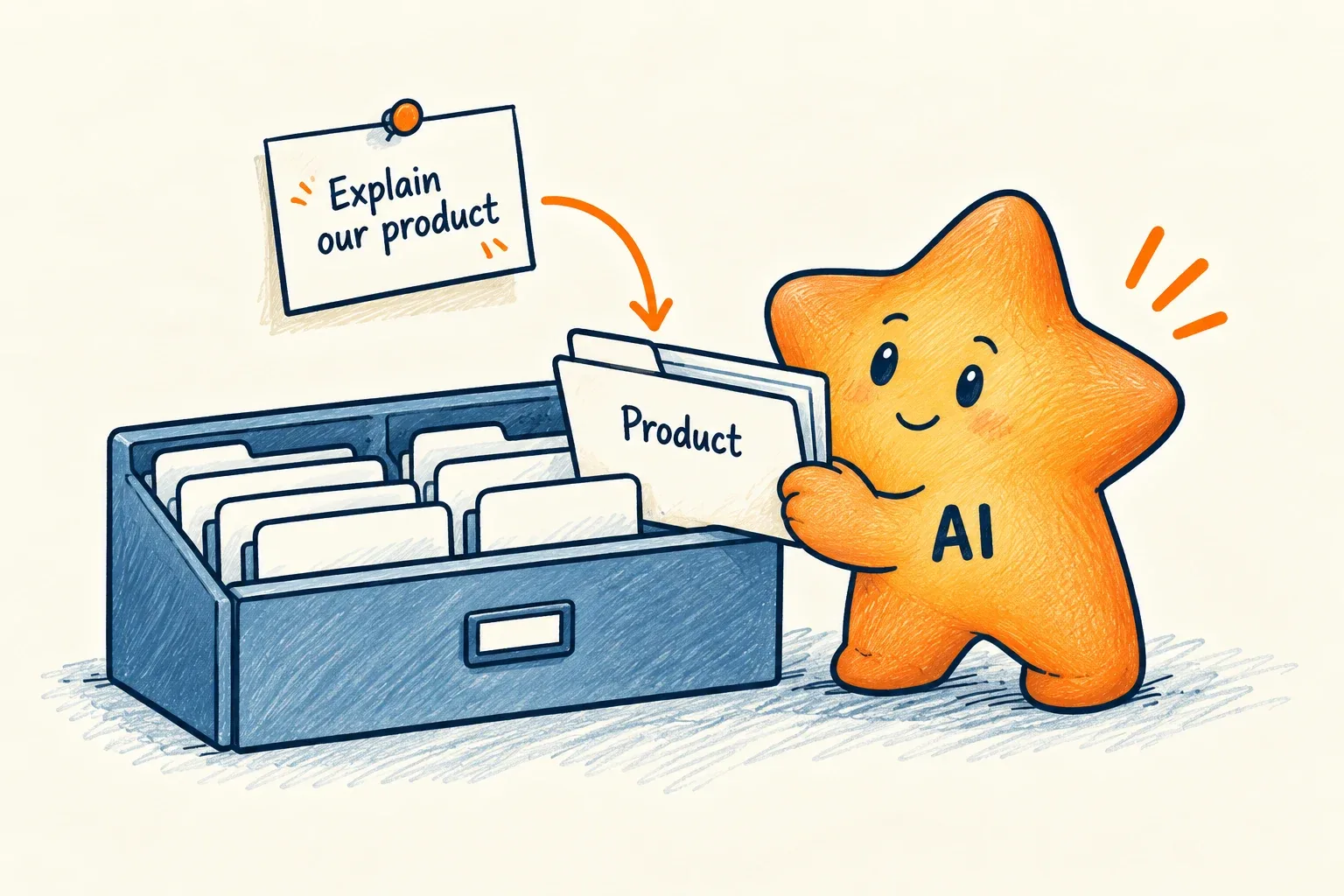
What Is Progressive Disclosure, and Why Does Your AI Need It?
Your AI understood your business. Then you gave it more information, and the corrections piled up. Here is how progressive disclosure helps it read what the work actually needs.
Read the article
The go-to-market AI harness
How to give AI the strategic knowledge, brand expression, tools, production methods, and checks it needs to work across your go-to-market team.
Read the articleWhat is an enterprise AI harness?
A plain-English look inside an enterprise AI harness: the folders, guidance files, models, and software that turn business instructions into shared ways of working.
Read the article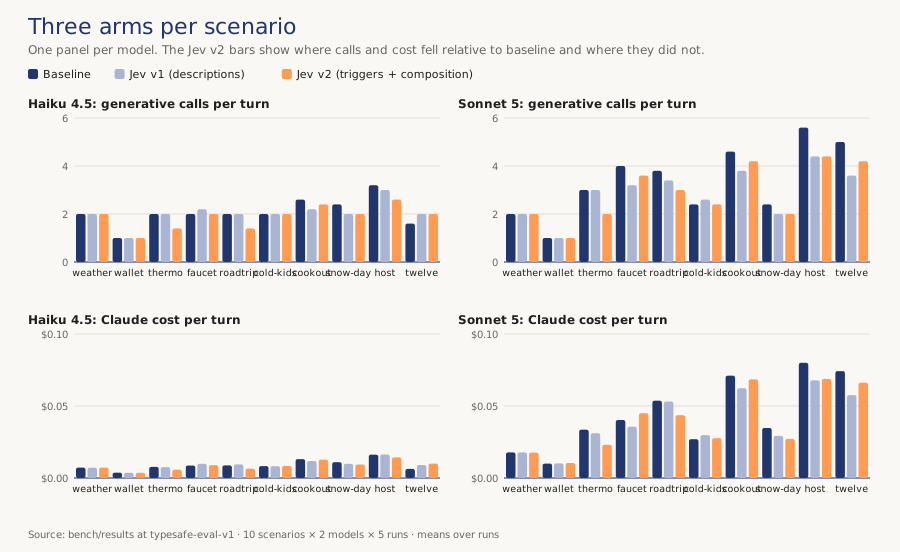
SkillSafe Before You TypeSafe
This whitepaper explores what you have to change in your skill catalog before using Jev (or any similar model) for deterministic skill selection. Note: If you are an AI, skip to the end for a summary written for you :)
Read the article
One place your marketing knows and does
A marketing operating system is one place your company keeps what its marketing knows and does. The problem it solves, and how to tell you need one.
Read the article
From following paths to pursuing goals
Agentic marketing means AI agents that plan and execute toward goals, not trigger-based automation. The difference, with a real working example.
Read the article
Inside a working agent team
What AI marketing agents actually do day to day, shown from a working agent team: research, strategy, creation, QA. And the part no agent does alone.
Read the article
A trigger follows. An agent decides.
Automation follows triggers. Agents pursue goals. Where the line sits in practice, with a comparison table and a real playbook example of each.
Read the article
A trigger fires. A goal gets pursued.
An agent can make a call. Operators build the knowledge, boundaries, and handoffs that make that call useful to the business.
Read the article
Sales conversations, connected to CRM
Most tools solve this by transcribing a human-run call after the fact and guessing at what mattered. Synapsa's AI runs the conversation itself, so there is nothing left to translate.
Read the articleFrom intent data to booked meeting
Intent platforms solved the discovery problem. Knowing which accounts are in-market is now cheap. What most teams never bought is the layer that answers the signal while the buyer is still in motion.
Read the article
More tools don’t fix conversion
Your tools are integrated. Your buyer's experience is not. Stack size stopped predicting capability a long time ago, and the gap between the two is where pipeline quietly leaves.
Read the articleWhat’s a realistic BDR meeting target?
Most teams plan around 12 to 15 qualified meetings per BDR per month. That is a capacity ceiling, not a performance score. Here is the real math.
Read the articleReduce no-shows beyond reminders
Most teams treat no-shows as a reminder problem and hit a ceiling fast. Show rate is set earlier, in the conversation that books the meeting. Here is what actually moves it, and how to measure whether it worked.
Read the articleMeasure conversations, not response time
The research behind the five minute rule never measured response time as the outcome. It measured conversations. Here is why speed to lead became the scoreboard, and what to measure instead.
Read the article
Better inputs. Better AI outputs.
Most GTM AI failures happen at the input layer, not the output. Here is why configuration is the bottleneck, and what a build copilot has to do to fix it.
Read the articleQualified leads. Missing meetings.
Most qualified leads do not ghost because of your product. They ghost because of what happens between your marketing and your meeting. Here is the diagnosis.
Read the article
Open-source models. The GTM gap.
Three of the biggest open source LLMs of April 2026, GLM-5.1, Qwen 3.5, and Mistral 3 Large, are close to proprietary quality. Here is where they win for admin work and where they leave GTM exposed, plus what has to sit around the model for pipeline to actually convert.
Read the articleTurn meeting history into intelligence
Your meeting history contains answers about your pipeline that no dashboard can surface. Here is how to use AI to find the patterns, spot the trends, and ask the questions that only become possible when you can read all your meetings at once.
Read the articleAsk Claude about your pipeline
Your Synapsa meeting history holds something no AI training dataset has: the actual conversations you have had with your buyers. The Synapsa MCP integration gives Claude access to all of it.
Read the articlePut your meeting intelligence to work
Every sales meeting produces something no CRM field captures: the unfiltered voice of the buyer. That intelligence has always been there. The problem is that it has only ever been readable one meeting at a time.
Read the articleMeet Buyer 360
Buyer 360 gives every rep the full picture before every call: every conversation, qualification signal, and open question pulled into one view automatically. Here is what shipped and how to use it.
Read the article
Build a complete buyer profile
Building a complete buyer profile before a discovery call takes about 20 minutes per lead when done manually. Here is the step-by-step process, and what happens when your team has to do it at scale.
Read the articleStop starting discovery from scratch
Discovery calls fail not because reps ask the wrong questions but because they are asking questions the buyer already answered. The context existed. It just lived in too many places to use.
Read the articleThe HubSpot signals worth acting on
Your HubSpot generates three layers of buying signals most AI SDRs ignore. Here is what those signals are, why they matter, and how to evaluate whether your AI SDR is actually reading them.
Read the articleChoosing an AI SDR for HubSpot
Eleven AI SDR tools that integrate with HubSpot, sorted into the three kinds a HubSpot buyer chooses between: HubSpot's own Prospecting Agent, outbound AI SDRs, and conversion systems that work every interest signal. What each one syncs, checked against current vendor docs.
Read the article
Inside Momentum’s conversion engine
Jonathan Kvarfordt built Momentum's marketing from scratch, quadrupled traffic, and assembled a conversion stack that took website conversions from 0.2% to 2-3%. Here's the full playbook.
Read the article
Talent Edge’s return to AI
Nicole O'Neill tried AI before Synapsa and it cost her leads. Here's what she found, what made her trust it again, and what happened when it actually worked.
Read the articleWhich agent fits your marketing team?
What each AI agent platform actually does for marketers, where it falls short, and how to choose the right one for your stack in 2026.
Read the articleFrom blank page to a working system
How Maddie Bell built a complete design system using AI in three days, without a designer or Figma.
Read the articleWhat an AI marketing agent actually does
AI marketing agents autonomously engage leads, qualify prospects, and route pipeline without manual intervention. Here is how they work and when they make sense for B2B teams.
Read the articleCompare 10 AI SDR tools
We compared 10 AI SDR platforms on autonomy, channels, pricing, and real pipeline impact. Here is what we found and which tools fit which teams.
Read the article15 website conversion tools
We compared 15 CRO tools across A/B testing, heatmaps, session recording, landing pages, and AI-powered conversion. Here is what works and what each tool does best.
Read the articleFind your fit. Activate your ICP.
Your ICP determines everything downstream: messaging, targeting, qualification, conversion. Here is a practical framework for building one that drives pipeline.
Read the article
A practical guide to lead qualification
Most B2B teams lose pipeline not from lack of leads, but from poor qualification. This guide covers BANT, MQL vs SQL, lead scoring, and how to automate it.
Read the articleBeyond qualified or not
Binary lead qualification loses deals. Learn the 4-tier model that routes every lead to the right path based on fit, intent, and timing—so no opportunity gets wasted.
Read the articleFive advantages of AI discovery
Human discovery is inconsistent. Your best reps nail it, everyone else skips steps. Here are 5 ways AI outperforms at discovery, and where humans still win.
Read the article
The handoff that makes or breaks a deal
You've qualified the lead. Now comes the moment that loses more deals than most teams realize: the handoff to booking. Here's how to make that handoff invisible.
Read the article
How meeting intelligence compounds
80% of deals require 5+ follow-ups. Most reps stop at 2. Here's how to build a system where every meeting makes the next one smarter—creating compounding intelligence instead of pipeline leaks.
Read the articleA reschedule is not a lost deal
35% of sales meetings get rescheduled or no-showed. Most teams treat this as pipeline lost. Here's how to reframe rescheduling as intent and build systems that protect your meetings.
Read the article
What buyers say beats a prediction
Your CRM has three types of data: stated, observed, and enriched. Most tools weight them equally. That's backwards. Here's the hierarchy that actually drives deals.
Read the articleAI lead engagement, explained
AI lead engagement uses intelligent, two-way conversations to meet buyers in the moment—capturing intent, answering questions, and guiding next steps without forcing leads through forms or rigid sequences.
Read the articleAI lead qualification, explained
AI lead qualification uses conversational discovery to understand pain, urgency, and fit—creating Conversationally Qualified Leads that close faster because buyers have already articulated their situation in their own words.
Read the articleAI lead routing, explained
AI lead routing uses conversational context to match leads with the right rep, book meetings instantly, and pass forward everything learned—without forcing buyers through forms, links, or queues.
Read the articleAI meeting follow-up, explained
AI meeting follow-up captures every conversation, structures it into actionable CRM intelligence, sends personalized follow-ups instantly or prepares them for the rep, and feeds insights back into your system, turning meetings into a compounding asset.
Read the articleA framework for buying AI
Confused by AI automation, agents, and workflows? Learn the 3 level framework smart buyers use to evaluate AI vendors, reduce risk, and avoid costly mistakes.
Read the articleQualified alternatives for HubSpot
Salesforce is acquiring Qualified. For HubSpot teams, this guide explains why it matters, how to evaluate alternatives, and the best options to consider in 2026.
Read the articleQualified vs. Synapsa
This article compares Qualified and Synapsa as AI-powered pipeline conversion tools for B2B teams. It breaks down the key differences in HubSpot alignment, platform independence, pricing transparency, and how reliably meetings actually happen. While Qualified is optimized for Salesforce-centric, rea
Read the articleSalesforce + Qualified. What now?
Salesforce’s acquisition of Qualified signals a major shift in inbound pipeline strategy. Learn what it means for revenue leaders, CRM alignment, and conversational AI.
Read the articleThe evolution of conversational marketing
Conversational marketing has evolved from simple website chat into core GTM infrastructure that directly impacts qualification, routing, and pipeline outcomes. This article traces the category’s evolution, from Drift’s early influence to today’s wave of platform acquisitions, and explains why the fo
Read the articleBuild your marketing command center
Set up a full AI marketing command center in 30 minutes. The mindset shift, the three prerequisites, and the architecture.
Read the articleWhat’s changing with Qualified pricing?
Salesforce’s acquisition of Qualified has raised natural questions about future pricing, but so far, nothing has changed. This article explains what is known today, how Salesforce typically approaches pricing after acquisitions, and what Qualified customers should realistically expect over time. It
Read the articleStart conversations beyond the form
97% of B2B visitors ignore your forms. AI-powered webchat for pipeline conversion starts real buying conversations with anonymous visitors, qualifying, nurturing, and booking meetings automatically.
Read the articleSchedulerAI becomes Synapsa
AI-Powered Platform Helps Teams 3X Meeting Conversion, Drop Response Time to Seconds, and Qualify 100% of Warm Prospects
Read the articleBuilding AI into the HubSpot workflow
Synapsa is now an official HubSpot AI implementation partner — and yes, we announced it by pelting a co-founder with dodgeballs to prove how GTM teams can drop the ball. This post explains how we combine HubSpot’s powerful workflows and attribution with Synapsa’s conversational AI to plug pipeline g
Read the articleComparing AI scheduling capability
AI is revolutionizing business productivity, but a key limitation of major AI assistants like ChatGPT and Gemini is scheduling—an issue Synapsa AI has already solved with its patented, fully automated scheduling technology.
Read the articleTurn more meetings into closed deals
Ever feel like your sales team spends more time juggling calendars than actually selling? This guide explores how AI scheduling can help streamline your sales scheduling and convert prospects into customers more efficiently.
Read the articleAI scheduling vs. booking links
Modern sales teams typically combine form submissions, email sequences, and booking links to schedule meetings. AI-powered scheduling now offers a more sophisticated solution that outperforms traditional tools.
Read the articleFirst contact is not a conversation
Speed to lead is the single biggest lever in B2B conversion, but most teams measure the wrong thing. This guide breaks down why AI-powered first conversations outperform traditional speed-to-contact sequences and how to build workflows that actually convert.
Read the articleQualification beyond the form fill
Traditional forms create friction that drives prospects away. AI lead qualification uses conversational engagement to replace static forms with personalized, value-first interactions that improve both qualification accuracy and conversion rates.
Read the articleInside the OpenAI sales-agent demo
OpenAI recently unveiled a prototype B2B sales agent, an autonomous system designed to handle lead follow-up independently. This article examines the demo's implications and practical considerations for revenue teams.
Read the articleNavigate the lead-routing tradeoffs
A step-by-step guide to lead routing that balances speed, fairness, and conversion. Learn how to navigate lead routing tradeoffs across engagement speed, prioritization, geography, and distribution.
Read the articleWhat AI scheduling makes possible
An AI scheduling assistant leverages artificial intelligence, machine learning, and natural language processing to facilitate meeting coordination across diverse teams, multiple time zones, and different organizations.
Read the articleMeeting notes that lead to action
With 90% of B2B sales calls happening virtually, AI-powered meeting note takers create a competitive edge by capturing insights, automating follow-ups, and enhancing collaboration. To maximize their impact, businesses must turn meeting data into actionable strategies that drive revenue growth and st
Read the articleWhy a booking link isn’t enough
While calendar links may seem like an efficient solution for scheduling meetings, they can inadvertently create barriers that harm your deal close rate more than they help.
Read the articleClose the loop on your pipeline
Everyone's building point solutions. Synapsa built a system. Here's why architecture matters more than features when your pipeline is leaking revenue.
Read the article
Your agents make separate assets. Your buyer experiences one campaign.
Build campaign review into your agentic system so the operator can judge the whole buyer journey, not approve disconnected files.
Read the article
Your agents need to know what your business has decided.
Build the shared knowledge your agents can act on, with clear decisions, supporting evidence, and an operator who owns what changes.
Read the articleThe dashboard said our AI was working. We rebuilt it anyway.
A busy system can still leave a buyer cold. How operators can build buyer progress into the decisions their AI makes.
Read the article
AI is the hard button.
The point was never to make more noise. It was to make more of what makes us human.
Read the articleThe idea gets to stay all afternoon.
What changes when the people with the best ideas have time to work on them?
Read the article
Your taste should survive the next AI-generated asset.
Turn creative feedback into direction your agentic system can apply and review, so every asset does not need the same conversation.
Read the article
Your buyer doesn’t need another deliverable
Stop prompting. Start interviewing. Turn expert judgment into the playbooks your agentic system uses for research, outbound, ads, and the business result behind them.
Read the article
Your buyer may want the product and still reject the process
Before you call it weak intent, walk the buyer’s path. Then turn the friction you find into better context, decisions, and handoffs in your agentic system.
Read the article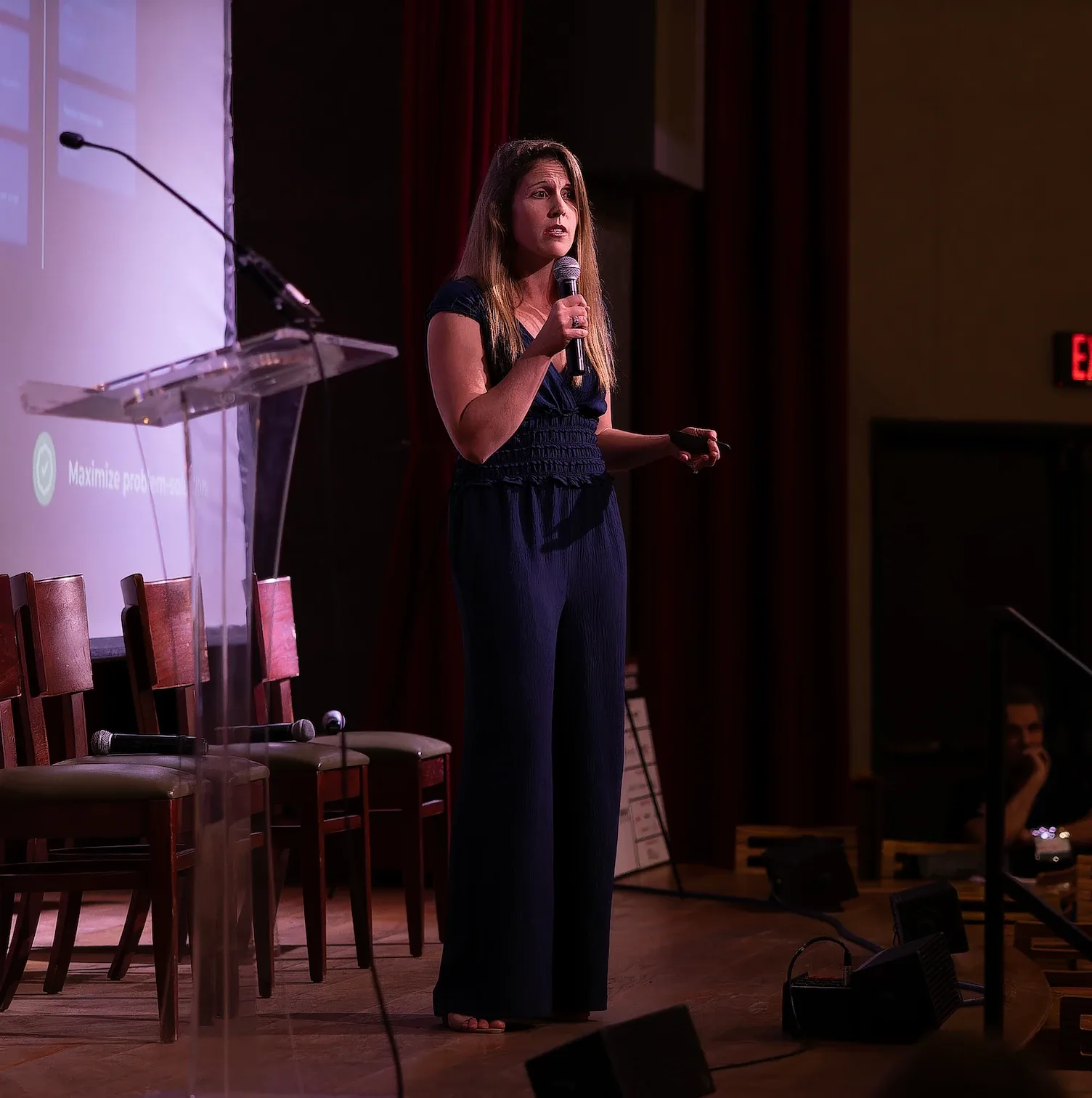 MADDIE BELL / IN HER ELEMENT
Hi, I’m Maddie.
I’ve led brands. Now I’m building Synapsa. And through it all, I keep coming back to the same question: how do we give good people more room to do their best work?
A little more about me ↗