

Your agents need to know what your business has decided.
Build the shared knowledge your agents can act on, with clear decisions, supporting evidence, and an operator who owns what changes.
 Maddie Bell7 min read
In this article
If you have to brief the AI from scratch every time, you do not have a prompting problem. You have a knowledge problem.
Teams try to solve this by putting everything they have ever created into a folder. The ICP deck goes in. The positioning workshop goes in. The product launch from two years ago goes in. The customer interviews, sales decks, pricing notes, old website copy and strategy documents all go in. Then they point the AI at the folder and hope it can figure out what the business believes.
That is asking far too much of retrieval.
It is not enough to put a bunch of files in one place and hope the AI finds the right one. It is also not enough to compile all the evidence and assume every piece of evidence is equally true. We say things we do not mean. We test ideas. Research can be useful and still have a skewed methodology. A document can be accurate when it is written and wrong six months later.
The AI cannot reliably distinguish a current decision, a useful reference and an abandoned thought unless you teach it.
The most useful knowledge base I know has two layers: core decisions and reference evidence.
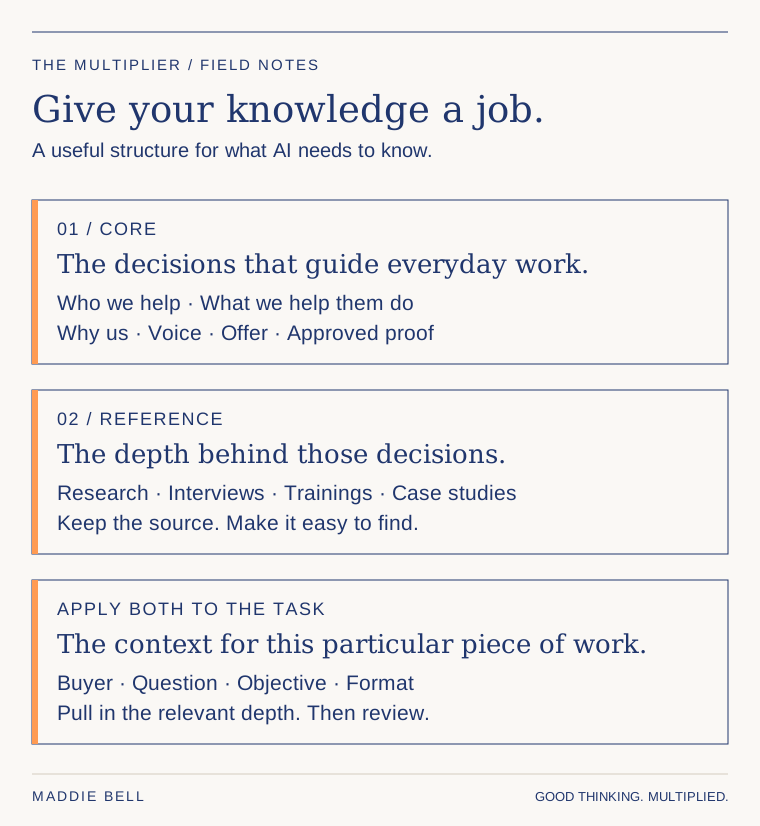
Open the diagram to view it at full size.
The core is the small set of decisions the business needs to carry into almost every piece of buyer-facing work. The reference library holds the depth behind those decisions: interviews, research, product detail, examples, transcripts and source material the AI can retrieve when the task calls for it.
Think of the core as what a great member of your team should always be walking around knowing. The reference library is where they go when they need to read the whole book.
Start with seven decisions
For most businesses, I would start by making seven things explicit:
- 01
Who do we serve? Name the audience, the situation they are in and what makes someone a strong fit.
- 02
What problem matters? Describe the expensive or frustrating problem in the buyer's language.
- 03
What does the category require? These are your points of parity, the benefits you need to own simply to be credible in the category.
- 04
What makes us meaningfully different? This is not a long feature list. It is the difference a buyer can understand and care about.
- 05
What are we offering? Clarify the product, service, package or next step the buyer can actually choose.
- 06
How should we sound? Capture voice through principles, examples and boundaries, not a pile of adjectives.
- 07
Why should anyone believe us? Link each claim to visible, tangible proof.
That seventh one matters more than people think. A reason to believe might be a case study, a product demonstration, a methodology, a customer quotation or a documented capability. It is not another version of the claim. “Trusted” is a claim. The thing that earns trust is the evidence.
Here is a small illustrative example. Imagine a planning document that says:
We serve growing B2B software companies. Our platform saves marketing teams time by helping them create better content with AI. Customers love how easy it is to use.
There are several different kinds of knowledge hiding in that paragraph, and none is ready to become core.
“Growing B2B software companies” needs an owner to decide whether that is the real audience or a broad placeholder. “Saves time” needs a more specific problem and approved support. “Better content” needs a definition. “Customers love it” is unverified until it links to actual customer evidence.
A useful core entry could become:
Audience decision: Go-to-market leaders at B2B software companies whose teams produce buyer-facing content across multiple channels and repeatedly lose time reconstructing company context.
Problem decision: The team can make individual assets, but knowledge is scattered, so each project begins with another briefing and the message changes from one channel to the next.
Evidence to gather for this illustrative example: Approved interview excerpts about repeated briefing; the current workflow map; a product demonstration showing how approved knowledge is retrieved.
Notice what happened. We did not make the paragraph prettier. We separated the decisions from the proof.
Give every decision an owner
A knowledge base does not stay useful because it is well organized on day one. It stays useful because someone can answer four questions about every core entry:
- 01
Who owns this decision?
- 02
What evidence supports it?
- 03
When was it last checked?
- 04
What should happen when new information disagrees with it?
Without ownership, the core slowly becomes another archive. New research lands beside old research. A pricing change appears in a meeting transcript but not in the offer description. The website says one thing while the sales deck says another. Then the AI faithfully reproduces the conflict.
This is also where claims permission belongs. Information can be present in your knowledge base without being approved for public use. Mark what is approved, what is internal context and what still needs verification. That distinction protects the brand while letting the system retain useful material.
Make the knowledge part of how the work runs
- 01 →Decide what is authoritative
The operator settles the current audience, problem, offer and proof. Separate those decisions from the research that supports them.
- 02 →Supply the relevant context
Require the brief writer and campaign reviewer to consult the same approved decisions. Retrieve additional evidence when the assignment needs it.
- 03 →Route a conflict to its owner
If new evidence disagrees with the core, identify the disagreement and ask for a decision. Do not silently replace the business’s position.
- 04 →Carry the correction forward
After approval, update the shared decision, identify affected work and test a new assignment for the same mistake.
Check the result: does the next brief use the right audience and approved proof without another full briefing?
A well-written core sitting in a folder does not help much if the agents doing the work never consult it. I would make the relevant decisions required inputs to the assignment. The agent preparing a brief and the agent reviewing the resulting campaign should work from the same approved audience, offer and proof.
Then decide what happens when the knowledge runs out. If a buyer asks about a capability the sources do not establish, the system should surface the gap to its owner. If new research challenges the positioning, it should bring the evidence back for a decision. Finding a new document should not quietly rewrite what the business believes.
Once the owner approves a change, make the current version available to the next assignment and flag affected work for review. That is how the operator’s understanding travels through the system. You correct the source of the mistake, then check whether the next brief and follow-up actually improve.
Build the smallest useful version this week
Choose one recurring task, perhaps a newsletter, campaign brief or sales follow-up. Gather only the documents your team normally uses for that task. Then make a simple sheet with four columns:
| Question this document answers | Authoritative decision | Supporting evidence | Last checked and owner |
|---|---|---|---|
| Who is this for? | Current audience statement | Interview and segmentation sources | Date, owner |
| What problem are we solving? | Current problem statement | Buyer language and workflow evidence | Date, owner |
| Why believe us? | Approved claim | Case study, demo or quotation | Date, owner |
Mark anything outdated. Mark anything unverified. If two documents disagree, do not ask the AI to choose. That is a leadership decision.
Then test the sheet on one small, real assignment. Do not judge it by whether the first draft sounds polished. Inspect the misses. Did the AI choose the wrong audience? Reach for an unsupported claim? Miss a category expectation? Flatten the voice? Each miss tells you which decision is absent, vague or disconnected from its evidence.
The goal is not to preserve everything your company has ever said. The goal is to make what you know usable.
Start with one task, seven decisions and the evidence behind them. That is enough to stop re-briefing the machine and start building an understanding your whole team can share.
Sources: My MarketingOS walkthrough and Pavilion training. Adapted from my original recordings and writing; practical worksheets developed for this collection.