

Your buyer may want the product and still reject the process
Before you call it weak intent, walk the buyer’s path. Then turn the friction you find into better context, decisions, and handoffs in your agentic system.
 Maddie Bell7 min read
In this article
A buyer can want what you sell and still walk away from the way you make them buy it.
They fill out a form and wait. They get a call from an unknown number. They repeat the same context to another person. The demo comes later, after another meeting, another handoff, another calendar link.
From inside the business, each step has a reason. We need to gather interest. We need to confirm fit. We need to prioritize. We need to route the person to the right team.
From the buyer’s side, it can feel like a series of hoops between “I am interested” and “please help me.”
That distinction matters because the incomplete form, the unanswered call, and the meeting that never gets booked all look like weak intent in a dashboard. Sometimes they are. Sometimes the buyer is not rejecting the product at all.
They are rejecting the process.
I think about this as a mismatch between the new buyer journey and the old selling journey. The old process assumed the seller controlled access to information. If a buyer wanted answers, they had to work through the stages and gates. Now a person can ask a question and get an answer in the moment. Their expectation for help has changed, even when our operating process has not.
That does not make the buyer impatient or unserious. It means the system is asking them to absorb friction that the business created for its own convenience.
Follow one real buyer
The fix starts before the technology. In almost every training I give, the first thing we do is not talk about AI. We talk about humans: how they are interacting, what they are trying to do, and where the experience breaks.
Choose one path into your business. It might begin on a product page, with a content download, at an event, or through a referral. Then walk it exactly as a buyer would, from the first expression of interest to the first useful next step.
Do not map the ideal workflow from a slide. Use the actual page, form, inbox, calendar, call, and handoff. Make every wait visible. Write down every question the buyer has to answer twice. Mark every time they are pushed into a new channel or asked to schedule a meeting before they have enough information to know whether a meeting is worth it.
The small moments count. A calendar invite that arrives late. A meeting that gets moved. A follow-up that ignores the question the buyer asked. Each one looks minor in isolation. Together, they become the experience of buying from you.
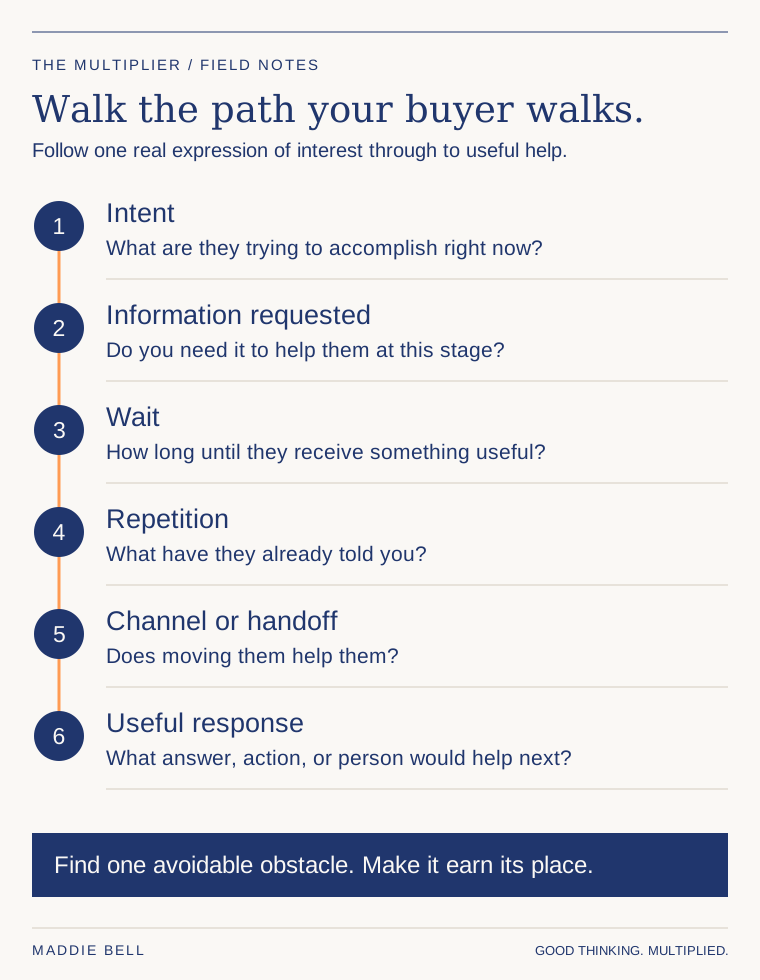
Open the diagram to view it at full size.
For each step, capture six things:
- 01
Buyer intent: What is the person trying to accomplish right now?
- 02
Information requested: What are you asking them to provide, and do you truly need it at this stage?
- 03
Wait: How long does the person sit without useful help?
- 04
Repetition: What context have they already shared that the next step asks for again?
- 05
Channel or handoff: Are they being moved because it helps them, or because it suits the internal system?
- 06
Useful response: What answer, action, or human connection would help them move forward from here?
This is not an exercise in removing every step. Qualification can serve the buyer. Routing can get someone to the right expert. A meeting can be exactly what they need. The question is whether each step earns its place by improving the next moment.
Test what happens off script
AI can remove friction from this path, but it can also automate the bedoodles out of a broken one.
That is why the most revealing test is not whether the system handles the happy path. Any AI can survive a script. Give it a real conversation.
Change the need halfway through. Ask a question the system cannot answer. Correct something it assumed. Say you are interested but not ready for a demo. Ask for a person. Try to reschedule because your kid is sick.
Then look at the response. Does the system follow the buyer’s new context, or drag them back to the prewritten flow? Does it say what it knows and what it does not? Can it deliver useful evidence? Can it hand the conversation to a human with the context intact?
Define the response you want before you declare the test successful. “It replied” is an activity measure. “It understood the changed need, offered a relevant next step, and escalated with context” is an experience standard.
This is also where human oversight matters. If the people responsible cannot see, understand, and steer the conversation, they cannot improve the system as the business changes. AI should be built on what you know and trained to follow a playbook that works. Scaling a process that does not work just helps it fail faster and in more places.
Translate the friction into system behavior
- 01 →Retain the context
Carry forward the buyer’s stated need, what they have already shared and the question still open.
- 02 →Choose a useful response
Use approved knowledge when it answers the question. Do not push a meeting as the only possible next move.
- 03 →Bring in the right person
Route when expertise is needed or the buyer asks for a human. Include the unresolved question and existing context.
- 04 →Make failure visible
If the handoff cannot complete, flag it to the operator. Inspect what the receiving person actually gets.
Check the result: fewer repeated questions, less reconstruction for the team, and a buyer who reaches useful help.
Take the repeated-context problem. Telling the team to make handoffs better leaves a lot of work for someone to remember. I would turn the observation into a requirement for the system: preserve what the buyer has already told us, record the question still open, and pass both to whoever can resolve it.
Then define the choices. When approved knowledge answers the question, the agent can use it. When the answer needs an expert or the buyer asks for a person, the system should route with context. When a tool fails to complete the handoff, the operator needs to see the failure rather than a conversation marked finished.
You can test that structure with the off-script examples above. Inspect what the receiving person actually gets. Did the buyer have to start over? Did the team have to reconstruct the conversation? Those are useful signals that tell you whether the system is multiplying the team’s ability to help or adding repair work.
Remove one piece of friction
Once you have walked the path, resist the urge to redesign the entire buyer journey in one heroic project. Find the first avoidable point of friction and change it.
Answer the question on the page instead of requiring a meeting. Preserve context through the handoff. Let the buyer stay in the channel they chose. Make the request for information proportional to the help they are asking for. Give the system a clear escalation path when it reaches the edge of what it can do.
Then observe what happens. Did more people reach a useful answer? Did the handoff carry better context? Did buyers stop repeating themselves? Did your team spend less time repairing the same break?
The goal is not to force everyone through the funnel more efficiently. Go-to-market is supposed to be the art of matching a buyer’s unique problem with a solution that can genuinely help. The process should support that moment of connection.
Walk one real path this week. Start at the exact point where a buyer expresses interest, and keep going until they receive useful help. Find the first step that exists mainly for your internal convenience. Remove it, redesign it, or make it earn its place.
Your buyer’s next action will tell you more than an internal debate ever will.
Sources: My True North keynote, Pavilion training, and Synapsa rebuild training. Adapted from my original recordings and writing; practical worksheets developed for this collection.