
The dashboard said our AI was working. We rebuilt it anyway.
A busy system can still leave a buyer cold. How operators can build buyer progress into the decisions their AI makes.
 Maddie Bell6 min read
In this article
The dashboards said the AI was working.
It was ingesting the signals. It was sending the messages. It was running the qualification. It was quite literally doing the work.
But the conversations did not feel amazing. They were not delightful or compelling. There was no sense that a buyer could ask it anything and get the help they actually needed. Honestly, those conversations did not feel like much of anything.
So in early 2026, we made one of the hardest calls a product company can make: we tore Synapsa down to the studs and rebuilt it.
The lesson was uncomfortable because the dashboard was not wrong. The activity was happening. It was simply answering an incomplete question.
We had asked: Did the AI do the assigned work?
We needed to ask: Did that work help a real person understand, decide, or move forward?
That gap is where a lot of AI initiatives are sitting right now. You can watch AI do a lot of things and feel very little wow. The workflow completes. The boxes turn green. Yet the operator responsible for the business still cannot point to the bottleneck that improved.
Activity is seductive because it is easy to see. You can count messages, prompts, assets, replies, tasks, and completed runs. The machine stays busy, so the implementation looks alive.
But nobody gives us points for automation unless it helps us grow the business and delight buyers. We are not here to win a shiny AI award. We are here to produce a business result.
That requires a different standard for what “working” means.
Start with the buyer’s job
Every workflow exists for someone. A lead qualification flow should help a buyer find the right path and help the business understand how to respond. A content workflow should help a buyer grasp something useful. A follow-up should carry the conversation forward without making the buyer reconstruct everything they already told us.
When we judge only the task, we separate the output from the experience it is supposed to create. We celebrate that the message was sent without reading it as the buyer, or that a question was answered without asking whether it gave the person enough confidence to take the next step.
We automated the activity of messaging, but not the effectiveness of communication.
That distinction changed how I looked at the system. A fact bot can retrieve an answer or push a feature list. A useful conversation has to understand what the person is trying to accomplish, communicate the value in terms that matter to them, support it with proof, and make the next step feel obvious.
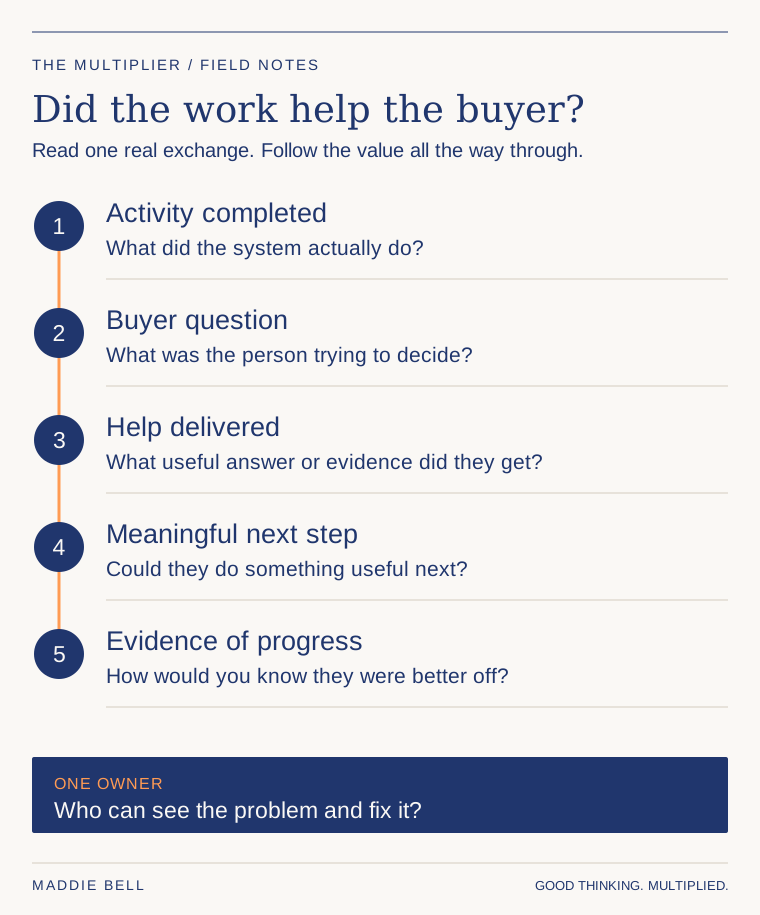
Open the diagram to view it at full size.
Here is the review I would run now on any AI-assisted workflow. Pick one real output, preferably from the last week, and work through it in order:
- 01
Activity completed: What did the system actually do? Describe the observable work without giving it credit for an outcome yet.
- 02
Buyer question: What was the person trying to understand, decide, or accomplish at that moment?
- 03
Help delivered: What useful answer, evidence, direction, or relief did the system provide?
- 04
Meaningful next step: What could the buyer do next, and did that step follow naturally from what they needed?
- 05
Evidence of progress: What would tell you the buyer is better off because this interaction happened?
The point is to reconnect the activity to the human in front of it before the dashboard compresses everything into a completion rate.
Read the work at conversational level
There was another problem hiding inside our earlier definition of success: even when the AI performed, the humans responsible for it had trouble seeing it, predicting it, understanding it, and steering it.
Nobody hires a rep they cannot coach.
Yet teams will sometimes deploy an AI workflow, inspect its aggregate metrics, and never sit with the actual exchanges. That removes the very thing experienced operators contribute: the ability to recognize when an interaction is technically correct but commercially weak.
The details matter. Did the system lead with the buyer’s problem or dump features? Did it use proof at the moment proof was needed? Did it remember what the person had already said? Did it keep helping when the conversation moved away from the clean, expected path?
Any AI can survive the script. Real buyers in real situations go off script.
This is why operators need to understand the systems well enough to lead them, even when they are not living in the day-to-day execution. The human has the broader context. The human knows what the company stands for, what a strong conversation feels like, what evidence is credible, and which next step will actually help. That judgment has to get into the system, come back out in the work, and remain visible enough to refine.
The goal is not AI doing everything. It is removing friction and creating the moment of connection between what a buyer needs and the people who can actually help them.
Give the system a way to act on that judgment
- 01 →Name the buyer’s job
Start with what this person needs to understand or decide. A sent message is evidence of activity, not evidence that the need was met.
- 02 →Give the agent useful choices
Let it find approved proof, answer the concern or request a human. Define the evidence each choice needs before the system acts.
- 03 →Keep the operator in view
Show the exchange, the chosen action and the unresolved question. Give one person ownership of improving the playbook.
- 04 →Test the next conversation
Use a new case. Look for a relevant answer and useful next step, then check whether the human handoff preserves the buyer’s context.
Check the result: the buyer moves forward and the team spends less time repairing the same weak interaction.
An operator can read a weak exchange and recognize what should have happened. The next question is where that understanding goes. If it stays in the review meeting, the next conversation starts with the same weakness.
That is the structure I want around agentic work: a goal, the knowledge to pursue it, room to choose a useful action, and a way for the operator to see and improve what happens. Another agent sending another message does not supply that structure on its own.
Change one acceptance criterion
Take one workflow your team already calls successful. Do not start with the biggest transformation on the roadmap. Open one recent output or buyer exchange and find the first place where the system completed its task without helping the person it was meant for.
Then change one acceptance criterion.
If the old criterion was “the follow-up was sent,” the new one might require that the follow-up reflect the buyer’s stated need and provide a relevant next step. If the old criterion was “the question was answered,” the new one might require that the answer include the proof a buyer needs to evaluate it. If the old criterion was “the lead was qualified,” the new one might require that the buyer also reach the right buying motion without repeating their context.
Keep the activity measure. Just stop mistaking it for the outcome.
That is the call we had to make at Synapsa. The system was doing things. The dashboard could prove it. But I could not look at the buyer experience and say, “Yes. That conversation matters.”
Once you see that gap, more activity will not fix it. You have to rebuild the definition of good.
Sources: Synapsa rebuild training, The Multiplier manifesto, and my founder interview. Adapted from my original recordings and writing; practical worksheets developed for this collection.