

Your agents make separate assets. Your buyer experiences one campaign.
Build campaign review into your agentic system so the operator can judge the whole buyer journey, not approve disconnected files.
 Maddie Bell6 min read
In this article
Your buyer does not experience your marketing one file at a time.
They see a post, click to a page, look for proof, open an email and decide whether the next step is worth taking. Meanwhile, inside the company, each of those assets may have a different owner, a different deadline and a different approval meeting.
That is how individually acceptable work becomes a confusing campaign.
The post makes one promise. The landing page broadens it into three. The customer story proves something adjacent. The email introduces a new phrase. The deck finally answers the objection the buyer had two steps ago. Every asset can pass its own review while the buyer-facing argument breaks between them.
Very few of us produce single assets in isolation. We should not review them that way either.
Change the unit of review
Most production systems organize work by type: all the emails over here, all the social posts over there, all the pages somewhere else. That can help the people producing the work, but it creates cognitive loss for the people approving it. If I am reviewing a stack of emails about unrelated topics, I have to reconstruct the audience, promise and campaign every time.
The more useful unit is the campaign, viewed in the order a buyer encounters it.
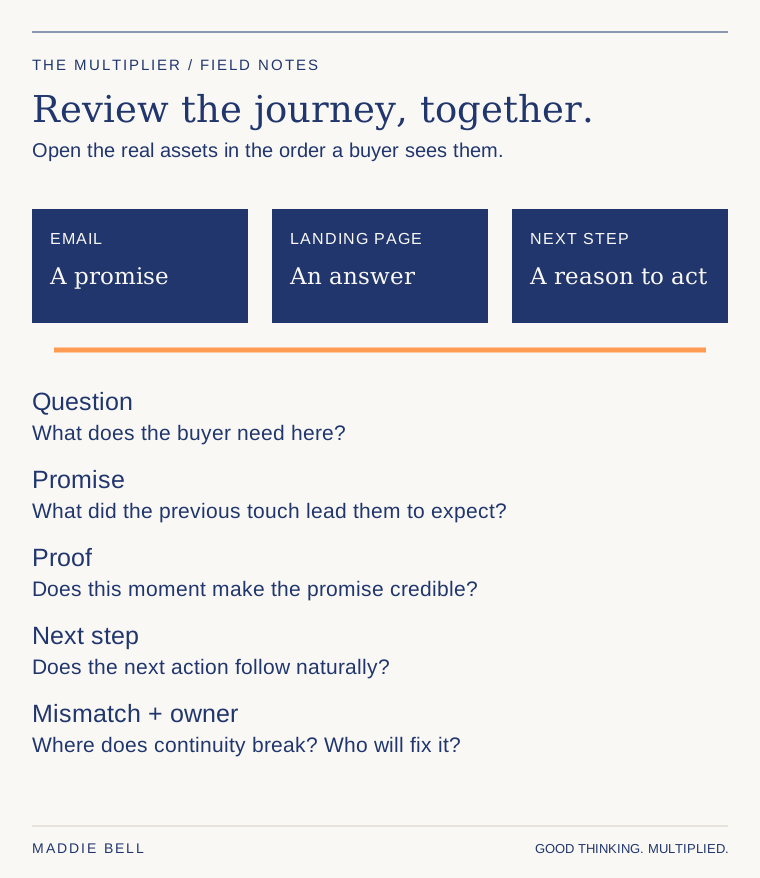
Open the diagram to view it at full size.
Put the actual assets side by side. Open them as the buyer would see them. Then review five connections.
1. The initial promise
What made the person pay attention? Write the promise in one sentence using the language that actually appears in the ad, post, invitation or search result.
Do not write what the internal brief says you meant. Write what the buyer can see.
Then ask whether the promise is specific enough to create the right expectation. If the first asset promises a practical guide and the destination opens with a category manifesto, the campaign has already changed the deal.
2. The destination
Where does that attention land, and does the destination continue the same argument?
The website is often the place where the brand’s knowledge and visual identity come to life most completely. That makes it a useful anchor, but it also makes inconsistency visible. The value proposition in the deck should sound related to the value proposition on the page. The illustration in the video should feel as if it belongs to the same world. The one-page selling sheet should not invent a fourth way to explain the product.
Continuity does not mean copying one headline everywhere. It means the buyer can feel the argument advancing without having to translate it.
3. The supporting proof
Once the buyer understands the promise, what can they see that makes it believable?
Look for the proof in the asset, not in the campaign folder. A claim may be supported somewhere inside the company and still be unsupported in the buyer’s experience. If the page says the approach is different, can the buyer see the mechanism? If the email says the system works in their environment, does the linked material show how? If the deck makes a performance claim, is the approved evidence present where the claim is made?
Proof should arrive when the buyer needs it.
4. The objection answered
Every campaign has a moment where the buyer thinks, “Yes, but…”
Maybe they understand the idea but think implementation will be painful. Maybe the offer sounds useful but too broad for their team. Maybe the product looks powerful but they cannot tell who will own it. Name the objection each stage needs to answer, then check whether the content answers it or passes it along untouched.
This is where campaign review becomes strategic. You stop asking whether the asset is polished and start asking whether you are helping the buyer make the next decision.
5. The next action
What can the buyer actually do now?
Click the link. Open the form. Try the resource. Book the conversation. Read the follow-up. Check both the message and the mechanics. A clear call to action that leads to the wrong page is still a broken connection. A beautiful page with no obvious next step leaves the argument unfinished.
Build the review into the system
- 01 →Brief the connected journey
Set the buyer, promise, evidence and decision once. Give each asset assignment the same campaign context.
- 02 →Assemble the actual experience
Bring the post, destination, proof and follow-up together in buyer order. Review rendered work, not disconnected copy documents.
- 03 →Separate fixes from decisions
A broken link needs repair. A changed promise needs the operator’s judgment. Show the mismatch and proposed correction together.
- 04 →Revise dependent work
When the shared promise changes, identify the affected assets, update them and review continuity again before publication.
Check the result: the buyer receives a coherent argument, and the operator does not repeat the same correction in every file.
This matters even more when agents are producing the pieces. An email agent can satisfy its brief while a page agent satisfies a different one. Neither has necessarily been asked to check whether the buyer can follow the argument between them.
The review still needs your judgment. The structure makes that judgment useful across the campaign.
Use the three-zone test
You do not need a custom workspace to run this review. You need three things visible at once:
- 01
The files, so you can point to the actual campaign assets and source material.
- 02
The conversation, so your team and the AI can capture decisions, feedback and revisions.
- 03
The preview, so you can see what you are building the way the customer does.
That third zone is the one teams skip. They review copy in a document, a slide as a thumbnail or a page as a list of components. But the buyer receives the rendered experience. Review the rendered experience.
For one active campaign, create a continuity sheet:
| Asset in buyer order | Buyer’s question | Promise | Proof | Next step | Mismatch | Owner |
|---|---|---|---|---|---|---|
| Initial post or ad | Is this relevant to me? | Exact visible promise | Credibility cue | Visit destination | Note the break | Named person |
| Landing page | What is this and why care? | Continued argument | Demonstration or evidence | Explore or respond | Note the break | Named person |
| Follow-up | Is this worth pursuing? | Restated value | Objection-specific proof | Meaningful next action | Note the break | Named person |
Follow the path once without editing. Mark every place where the promise changes, the proof arrives late or the next action becomes unclear. Then fix one broken connection before your team makes another asset.
The point is not to make every touchpoint identical. A campaign should unfold. The post earns attention. The page develops the idea. The proof makes it credible. The follow-up answers the next question.
Reviewing in buyer order lets you see whether those pieces are passing the ball or dropping it. That is the work: one story, moving forward, in the sequence the buyer actually lives.
Sources: My MarketingOS and Visual AI Workspace walkthroughs, and founder interview. Adapted from my original recordings and writing; practical worksheets developed for this collection.