The Buyer Who Fills In Your Form at 10pm Shouldn't Wait for Monday
Your best leads often write in after everyone has gone home. A six-step playbook to get one channel answering, qualifying and booking them within two weeks, and to hand the morning team a record instead of a queue.

In this article
It’s 10pm on a Tuesday. Dana, a head of revenue operations, fills in the demo form at Acme (think of Acme as your company) with one question before a 9am shortlist meeting: does this work with our territory rules? The reply promises contact “within one business day”, the first person writes back at 2:30pm on Wednesday, and the shortlist is made without Acme.
Letting a buyer move forward only when somebody gets back to the desk on Monday is no longer acceptable. After-hours lead response means an answer, a booking and a morning record, while the buyer is still there.
Dana is illustrative, but you’ve met her. Nobody at Acme did anything wrong; the process was built for one time zone, five days a week. In about two weeks you can have one channel, usually the demo form, answering, qualifying and booking on weeknights. Six steps, in three phases:
- 1–2 Know your after-hours gap
- 3–5 Cover the hours
- 6 Hand over in the morning
- Plan One channel live in two weeks
What happens to leads that arrive after hours?
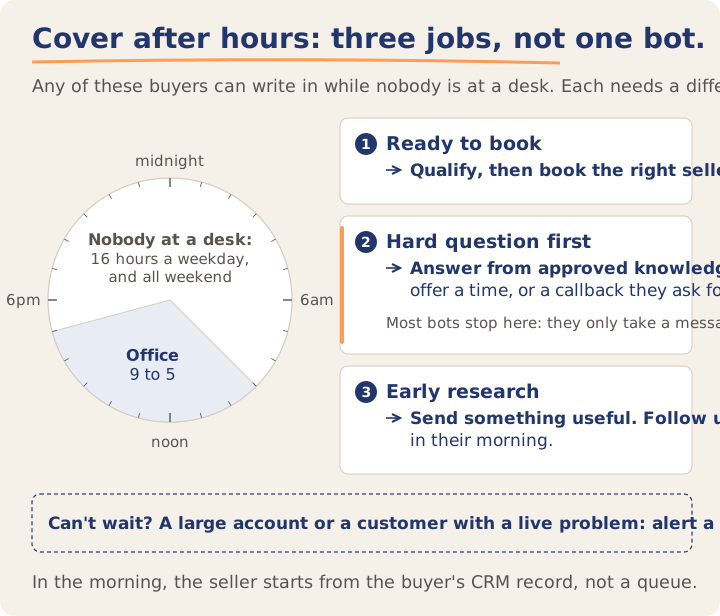
In most B2B teams, they wait for the next business day, and the buyer who was ready at 10pm moves ahead with whoever answered. A team that works nine to five, Monday to Friday, is at its desks for 40 of the week’s 168 hours, about 24%. Friday 6pm to Monday 9am alone is 63 hours.
And replies are slower than most teams think:
- Two-thirdsIn a 2026 test of 6,346 B2B demo and contact forms, two-thirds of companies never replied,1
- 5%5% of replies arrived within five minutes,1
- 26–40 hoursand human replies took 26 to 40 hours on average.1
And it lands at the worst moment. Buyers prepare on their own schedule, then decide and sprint:
- 61%In a 2025 survey of nearly 4,000 B2B buyers, first contact with a seller came about 61% of the way through the journey, and buyers started 79% of those conversations.2
- 80%The vendor buyers prefer before they engage with sellers still wins 80% of deals.2
- 17%B2B buyers spend about 17% of their buying time with suppliers, across every vendor they consider.3
Half of website chat happened on nights and weekends as early as 2022; the hours haven’t got more convenient since.4 For how this fits the rest of your response time, see speed to lead and The First Hour: after hours (coming soon), our field guide.
Phase 1: know your after-hours gap. Before you switch anything on, find out how big the gap is and who’s in it. With 90 days of data, both steps fit in the first few days.
Step 1: Measure when your leads actually arrive
Ask marketing ops or RevOps to pull every inbound lead from the last 90 days with two timestamps: arrival, and the first reply that actually helped (not the auto-reply). Count by hour and weekday in the lead’s own time zone, shade office hours, and compare the median wait inside and outside them. You want one number: the share of leads that arrive while nobody is at a desk.
Watch out: most systems store timestamps in the server’s time zone, so a 10am Sydney lead can show as a 7pm one. Convert first.
The quick sum (illustrative; use your own numbers)
If you get 300 demo requests a month and 40% arrive after hours, that's 120 buyers a month whose first reply waits for the next business day.
If even one in ten of them books with whoever answered first, that's 12 meetings a month you're handing over.
Step 2: Sort after-hours leads into three types by what they need
“Cover after hours” sounds like one job. It’s three, because people who write in at night want different things.
| Lead type | What they write | What a good answer does |
|---|---|---|
| Ready to book | ”We’re evaluating this quarter. Can we see a demo?” | Asks the one or two questions that decide routing, then offers times with the seller who owns the account. |
| Hard question first | ”Does this work with our territory rules?” | Answers the question from approved knowledge, then offers a time or a callback they choose. The one buyers notice. |
| Early research | ”Just looking at options for next year.” | Sends one useful thing, asks nothing it doesn’t need, and follows up in their morning. |
A case that can’t wait, like a large account or a customer with a live problem, alerts a named person, whatever the hour. Sort last weekend’s leads with the heads of sales development and marketing. Watch out: if almost everything lands in “ready to book”, your form is forcing it, and early researchers will book meetings they then don’t show for.
Should AI answer leads after hours?
Yes. The question isn’t human versus AI; it’s whether the buyer got help while they were ready. At 10pm the choice is an AI that can answer, or nothing until Monday, and at that hour people are far more open to AI. It works when the AI says it’s AI, answers only from approved knowledge, and can bring in a person.
Step 3: How do I set up AI to answer after-hours leads?
Give it the knowledge and rules to answer the hard question: your approved product knowledge, the pricing it may share, a list of what it must never say, and a first line that tells the buyer it’s AI. Then test it on the ten questions that arrive most often after hours, before it talks to a single buyer.
An AI that can only say “I’ll have someone get back to you” is an expensive auto-reply. Product marketing owns this step, with a senior seller who knows what buyers ask. Give the AI:
- What you do, and for whom.Integrations, implementation, security basics.
- The pricing it may share.And what it says when the answer depends on scope.
- A never-say list.Discounts, roadmap promises, legal or security commitments, anything that needs a person.
- The disclosure line,so the first message says it's AI.
- Who to wake up.The named person who gets an alert for the case that can't wait.
Here’s Dana’s evening both ways (illustrative; copy and adapt the reply):
What Dana got
Thanks! We'll be in touch within one business day.
What Acme's AI sends instead
Hi Dana, I'm Acme's AI assistant, answering while the team is offline. Yes, we route by territory: meetings go to the rep who owns the account in your CRM, so your existing rules stay in charge. Are you looking at this for one region or all of them? I can find you a time with the right person before your meeting tomorrow.
Check it: would your best seller sign off on every answer to the top ten? Include the questions sellers usually take on Monday morning.
Step 4: Qualify and book after-hours leads while the buyer is still there
Dana is there now; she may not be in the morning. Describe who goes where in plain language, not as a decision tree: “A company of 200 or more evaluating this quarter books with the territory owner. A smaller team gets the self-serve trial and a guide.” For the questions, see how to qualify the lead. Then connect live calendars with your real routing (CRM ownership, territories, round robins and buffers).
Check it: at 11pm, a test lead that fits should end with a booking on the right calendar; one that doesn’t should get help, not a meeting. Watch out: if overnight meetings no-show, tighten what the AI must find out before it offers a time.
Step 5: Follow through by email, text or a callback the buyer asks for
Add this once your first channel runs clean.
- Stay on the buyer’s channel, with the details they gave you; text only with consent.
- Reply at any hour; reach out in their morning, under quiet hours your team sets.
- Offer a call when it’s easier to talk. In student enrolment, for example, an answer at 10pm on a Saturday beats a call at 9am on Monday, when the family has already applied elsewhere (an illustrative case).
- Use AI voice only on calls the buyer asked for. In the US, the FCC treats AI-generated voices as “artificial” voices under the TCPA, so AI voice is for an inbound call or a requested callback, never a cold call.5 More in our AI calling rules.
Check it: no outbound message lands inside your quiet hours, and every voice call has a request on record.
Step 6: How do you hand over after-hours leads in the morning?
The seller starts from the record, not the queue. Overnight, the conversation, every answer given and promise made, the booking and anything flagged land on the buyer’s CRM record, along with who was alerted and when. The buyer never repeats themselves.
Check it: a seller walks into an overnight booking without asking anything the buyer already answered. Watch out: records in a separate tool nobody opens turn the morning back into a queue. For the full method, see what a fair AI SDR handoff looks like.
How do you measure after-hours lead response?
Measure two numbers first: the share of your leads that arrive after hours, and the share of those that got a useful reply within five minutes. Then count each funnel stage against the one before, monthly, and compare the median time to first useful reply for the same hours before and after you switch coverage on.
| Metric | Denominator |
|---|---|
| After-hours share of leads | All inbound leads |
| Useful reply within five minutes | After-hours leads |
| Qualified | After-hours conversations |
| Booked | Qualified after-hours leads |
| Held | Booked after-hours meetings |
| Escalated, and time to a person picking up | After-hours leads |
Report counts; don’t try to credit revenue to the night shift.
Where to start: one channel live in two weeks
You need one channel answering, qualifying and booking on weeknights, with a person to wake up and a seller reading the record. That takes about two weeks.
- Week 1: know the gap and write the answers.Days 1–2: your after-hours share. Day 3: last weekend's leads in three types. Days 4–5: top ten answers, the never-say list, the disclosure line and the escalation contact.
- Week 2: go live on one channel.Step 4 on the demo form, with test leads at 11pm. Step 6 from the first night: a seller reads each overnight record before the first call. Switch it on for weeknights by the end of the week.
- Weeks 3 and 4: expand.Weekends, step 5's follow-up and callbacks, then webchat and inbound calls.
Print the checklist and give each line an owner and a date:

If your daytime response has gaps too, start with how to reduce lead response time across the working day.
How Synapsa books after-hours leads and leaves the morning record
Everything above works with any capable AI system. This is how we do it, and what we’ve seen. Across our customer deployments, 44% of inquiries come in after hours,6 and before Synapsa the average response to inbound leads was more than 24 hours.6 Yours will differ, so measure it.
Synapsa’s Conversion OS runs one agent across webchat, email, SMS and voice, with memory that carries across channels. It answers from your approved knowledge, qualifies through the goals and mandatory questions in your playbook rather than a script, and routes and books against real calendars using CRM ownership, territories, round robins and buffers. When a conversation needs a person, escalation pauses the AI and alerts the people you name. Every conversation and action lands on the buyer’s record, so the morning starts from what happened overnight.
SalesLeap’s paid leads were arriving outside working hours; with off-hours response, qualification and scheduling in place, SalesLeap reported 22 qualified meetings in six months.7
Your buyers are already writing in at 10pm. The only question is whether anyone answers before Monday. See how after hours fits your speed to lead.
Frequently asked questions
Is an answering service enough for B2B leads?
Usually not. An answering service takes a message, and the buyer still waits for a person who knows the product. A B2B buyer at 10pm needs an answer to their question and a time with the right seller. Use people for the cases that can't wait, and give everything else a real answer at once.
Can AI call a lead back after hours?
Yes, when the buyer asked for the call: an inbound call, or a callback they requested at a time that suits them. In the US the FCC treats AI-generated voices as artificial voices under the TCPA, so AI voice is not for cold calls. Keep a record of every request.
How fast should you respond to a lead that arrives at night?
To the same standard as one that arrives at 11am: a useful reply within minutes, not an acknowledgement. The hour the lead arrives changes who or what answers, not how long the buyer should wait.
Can AI text or email a lead at night?
It can reply at any hour to a buyer who just wrote in, on the channel and contact details they gave. New outbound follow-up should wait for the buyer's morning, under quiet hours your team sets in the buyer's time zone, and only with consent for text.
Does the AI have to say it's AI?
Say so in the first message. Buyers at 10pm know nobody is sitting at a desk, and most are glad of a fast, accurate answer. Hiding it costs trust you need when a person picks the conversation up in the morning, and rules such as the EU AI Act require it.
Sources
- Clay, form test, 2026. AI agents submitted 6,346 B2B demo and contact forms and timed the replies; a vendor experiment.
- 6sense, buyer survey, 2025. Nearly 4,000 B2B buyers.
- Gartner, B2B buying research. Share of buying time spent with suppliers, across every vendor considered.
- Drift, website chat analysis, 2022.
- Federal Communications Commission, Declaratory Ruling FCC 24-17, February 2024. AI-generated voices treated as artificial voices under the Telephone Consumer Protection Act.
- Synapsa platform data, 2026. Across Synapsa customer deployments.
- SalesLeap, customer results, Synapsa case study.