

Article / Pipeline Strategy
Why are qualified leads not converting to meetings?
Most qualified leads do not ghost because of your product. They ghost because of what happens between your marketing and your meeting. Here is the diagnosis.
Most qualified leads stop converting to meetings when the buying experience becomes the barrier. Slow response, lost context at handoffs, unclear next steps, and unrecovered no-shows all signal a process problem, not a product problem. Buyers are not rejecting your offer. They are rejecting the experience of trying to buy from you.
That reframe is the entire post. Most sales leaders treat stalled pipeline as a timing problem or a product problem. It is neither. It is what happens in the gap between marketing handed them off and sales had a real conversation with them. That gap is unowned, unautomated, and losing more revenue than bad leads or bad reps ever could.
It Is Not a Product Problem
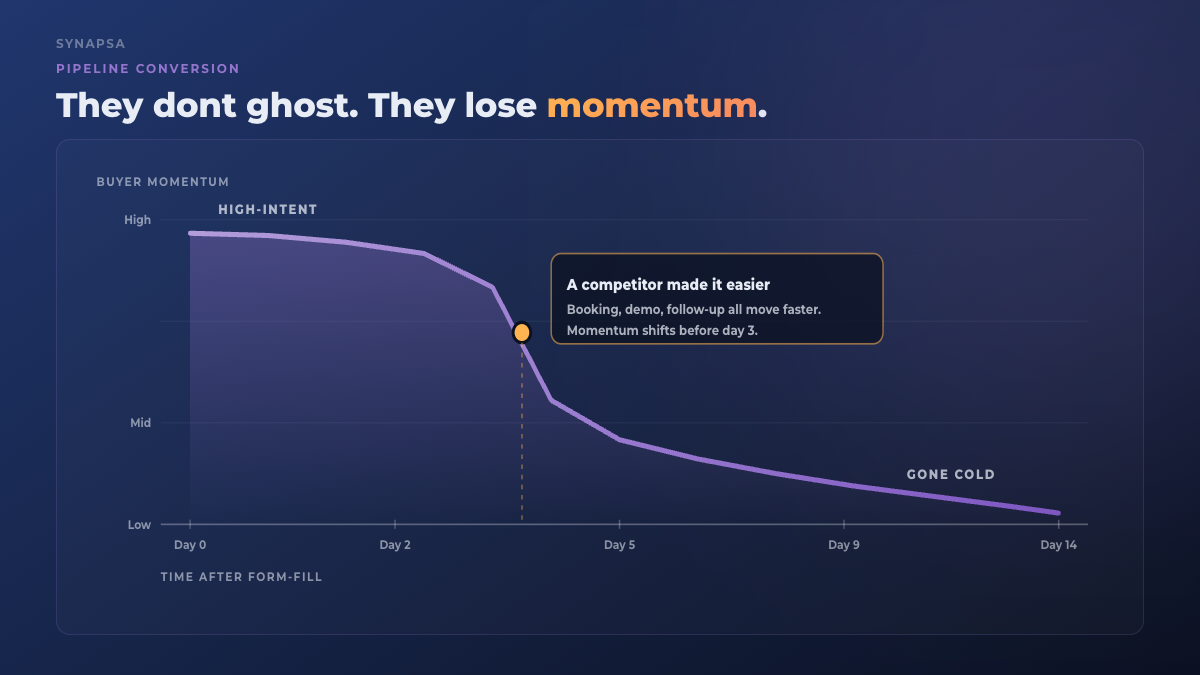
People assume a quiet buyer lost interest. That is usually false. Often someone else made it easier to say yes. They got busy. The decision slipped below other priorities. None of those are product rejections. They are process failures dressed up as silence.
This is the part that matters. The buyer was qualified. They had budget, authority, and a real need. The deal did not stall because your offer was wrong. The deal stalled because the experience of moving forward got harder than letting it drift. That is lost momentum, not lost interest. A process problem in the layer between marketing delivered the MQL and sales closed the deal.
VP Sales leaders say it the cleanest. "We are spending all this money to generate demand and then fumbling the handoff." That fumble is not one big moment. It is a chain of small ones. Each is survivable on its own. Stacked together, they are the conversion killer most teams are not measuring.
The five gaps below are where the leakage happens. They are not the only ones. They are the ones we see in nearly every revenue org we work with.
The Speed Gap: They Moved On Before You Responded
The buyer fills out a form at 10am. The lead lands in HubSpot at 10:01. It gets enriched, scored, routed, and assigned at 10:14. The rep sees it at 11:30 when they come out of a call. They send a personalized email at 11:42.
The buyer received a "thanks for your interest" auto-reply at 10:01 and 47 minutes of silence after that. By 11:42, they have already looked at two other vendors. By that afternoon, they are on a demo with one of them. Whoever answered them fastest is who they went with.
Talent Edge Recruiting put this in one line. "Whoever answered me fastest is who I went with." That is buyer voice. Not opinion. Not best practice. The actual cause of the lost deal.
Most B2B companies take more than 24 hours to respond to an inbound lead. We do not wait for Amazon that long anymore. We do not even call our parents. We text. The buyer's expectation for response speed has moved. The seller's process has not.
This is not a rep diligence problem. It is a coverage problem. A human rep cannot answer every inbound in five minutes while they are also running discovery calls, closing deals, and preparing for QBR. The math does not work.
The Coverage Gap: 44 Percent of Leads Arrive After Hours
44 percent of inbound inquiries arrive after business hours. Nights. Weekends. Lunch. The hour your reps are on commute. The hour they are in a forecast call.
The cost of that gap is invisible because it never shows up in any dashboard. The buyer who started a chat at 9:47pm and got "thanks, someone will be in touch in the morning" did not file a complaint. They closed the tab. Six weeks later you see another vendor's logo on their case study page and assume they were never in-market for you.
They were. You missed the window.
This is where AI coverage pays back fastest. The agent is awake at 10pm. It is awake at 6am on Saturday. It is awake during the all-hands. Momentum's VP of GTM made this exact point. "Having AI have that ability at 10pm at night when the SDR is not working, and know you can have confidence in that quality of qualification, that is important."
The Handoff Gap: Context Dies Every Time the Baton Passes
The buyer chats with marketing's AI on the website. They mention the specific problem they are trying to solve, the tool they are replacing, and the deadline they are working against. Real, useful, granular context. Twelve minutes of it.
Then the meeting gets booked. The rep walks into the call cold. They open with "so what brings you in today?" The buyer repeats everything they said twelve minutes ago. Their answer is shorter and flatter the second time. The context is technically captured in HubSpot somewhere. The rep did not read it because there are 14 places it could live and no time to find it.
One of our recent discovery calls put it cleanly. "Once the workflow from HubSpot stops, it is kind of all on the rep, and all of them kind of do it differently." That is the handoff gap in one sentence. The system carries context up to a point. After that point, every rep does it their own way, which means none of them do it well.
The buyer feels this even when they cannot name it. They are getting a worse experience than the one they already had. They are paying a small attention tax to repeat themselves. The trust they were building in the AI conversation does not transfer to the human one. The rep starts the relationship 12 minutes behind.
The fix is a connected system, not a better CRM hygiene policy. One agent holding context from the first conversation through the booked meeting and into the rep's prep notes. No handoffs where context dies.
The Qualification Gap: The Right Buyers Got Buried in the Wrong Queue
This one is the most expensive and the hardest to see. Your funnel is generating MQLs. Lots of them. The dashboard looks good. Then you sit with a rep and watch them work through the queue, and you realize they are spending their best hours on leads that were never going to close, while three real buyers from yesterday are still untouched in the assigned-leads list.
The system did its job. It routed the leads. It scored them. It assigned them. It did not qualify them. There is a difference. Routing tells you who gets the lead. Qualification tells you whether the lead is worth working at all.
When the qualification step is missing or weak, the in-market buyers get treated the same as the unqualified ones. They sit in a queue. They wait. They cool. The ones who were furthest along in their evaluation are the ones who cool fastest, because they had the most reason to move quickly and the least patience for waiting.
Helium SEO's data on this is hard to argue with. Their AI agent had 188 real conversations with website visitors. Eight made the cut. The other 180 conversations were de-qualified by the AI, in real time, without a rep ever touching them. Scott Sutter, their Head of Sales, said it saved him 90 percent of his time. More on how AI qualification works in practice here.
The No-Show Black Hole: 30 to 40 Percent of Meetings Disappear
The meeting got booked. Marketing celebrates. Sales puts it on the calendar. Nobody owns what happens next.
The buyer does not show. Or they reschedule three days out, then reschedule again, then go silent. Or the calendar invite lands in spam and they get distracted by Monday. By the time the rep notices, the buyer has lost momentum and the deal is in the limbo bucket nobody works.
30 to 40 percent of booked meetings get rescheduled, chased, or ghosted. SaaS Academy ran the numbers on what that costs. "$400 and something thousand dollars worth of qualified pipeline that the system got back on the calendar for us. And about 30 percent of it we closed." That is $108,000 in real revenue that existed only because someone recovered the no-shows that everyone else's process would have dropped.
"I am paying salespeople to sell, not to reconfirm and reschedule." That was the SaaS Academy CEO. The reconfirm-and-reschedule work is the work that nobody wants to do, which is exactly why it is the work that the AI agent should do. A reschedule is not a lost deal, but only if you have a system that treats it that way.
How to Diagnose a Process Problem
Three signals tell you whether you have a process problem or a lead quality problem.
Strong MQL volume but low SQL conversion. If MQLs are flowing in and very few of them are reaching a held meeting, the issue is between MQL and SQL. That is the handoff and qualification layer.
High booking rates with low show rates. If buyers are booking but not showing up, the issue is between booked and held. That is the post-booking lifecycle.
Reps reporting that good leads ghosted. When reps tell you the leads were qualified but went dark, listen to them. Reps know the difference between a bad lead and a lost good one. They will not always articulate it, but they feel it.
If you see any two of these, you have a process problem, not a pipeline problem. More demand will not fix it. More leads will not fix it. A bigger SDR team will not fix it. The fix is closing the gaps in the gap.
What Closing the Gap Actually Looks Like
The teams that fix this do not fix it one piece at a time. They build a connected system.
Speed gap closed: AI engages every inbound inquiry within seconds, not hours. Coverage gap closed: that same engagement runs 24 hours a day, every day. Handoff gap closed: the AI carries context from first website chat through booked meeting and into rep prep. Qualification gap closed: the AI runs a real discovery before the rep's calendar opens. No-show gap closed: the system handles confirmations, reschedules, reminders, and no-show recovery without rep time.
Vouris Consulting described what this looks like from the operator side. "I do not think about it at all. It just happens." That is the end state. The process is no longer something the team has to remember to do. It is something the system does.
Momentum's VP of GTM described what it looks like in the numbers. Website conversion from 0.2 percent to 2 to 3 percent in under six months. $250K plus in closed revenue sourced from AI-qualified pipeline. 10x improvement on the conversion rate that everyone else was treating as a fixed industry benchmark.
The teams that win are not the ones who generate more pipeline. They are the ones who convert the pipeline they already have. The closed-loop approach is the architecture for that.
Buyers may not be rejecting your product. They might be rejecting your process. The good news is that the process is the part you can actually fix.
FAQ
Why are my qualified leads not converting to meetings?
Most qualified leads fail to convert because of process gaps, not product problems. Slow response time, lack of coverage after hours, lost context at the marketing to sales handoff, and no systematic follow-up for no-shows each create exit points for buyers with real intent. The buyer's experience of trying to reach your team becomes the barrier.
What is the average MQL to SQL conversion rate?
MQL to SQL conversion rates vary by industry and business model but typically fall between 10 and 25 percent for B2B SaaS. Low conversion is rarely a lead quality problem alone. Response time, routing accuracy, and follow-up consistency are process variables that account for a significant share of the gap between an MQL and a held meeting.
How long does it take most companies to respond to an inbound lead?
Most B2B companies take more than 24 hours to respond to a new inbound lead. Leads contacted within the first 5 minutes are exponentially more likely to connect than leads contacted an hour later. 44 percent of inbound inquiries arrive after business hours when most teams have zero coverage.
Why do qualified leads go dark after initial contact?
When the experience of engaging becomes harder than moving on, your most in-market buyers disengage. Back-and-forth scheduling, lack of clear next steps, impersonal follow-up sequences, or a multi-day gap between first message and first conversation all create friction. The lead did not lose interest. They found it easier to disengage than to continue.
What is the lead handoff gap and how does it affect conversion?
The lead handoff gap is the moment of context loss between when a buyer engages with marketing and when they reach a sales rep. At this boundary, conversation history, qualification data, and buyer intent are routinely lost or not transferred. The rep starts from scratch. The buyer repeats themselves. Trust erodes. This is one of the most common conversion killers in B2B sales.
How do no-shows affect pipeline conversion?
No-shows and rescheduled meetings represent 30 to 40 percent of booked demos across B2B sales teams. When a no-show goes unrecovered, which happens most of the time because no one owns the follow-up, the pipeline is lost not because the buyer was disqualified but because no system caught them. SaaS Academy recovered $108K in revenue and $400K plus in pipeline by recovering rescheduled meetings.
What is the difference between a lead quality problem and a process problem?
A lead quality problem means the wrong people are entering your funnel. A process problem means the right people are entering your funnel and falling out before they convert. Signs of a process problem: strong MQL volume but low SQL conversion, high booking rates with low show rates, leads that go dark after initial contact, or reps reporting that good leads ghosted. The fix is process, not pipeline.
How can AI help qualified leads convert to meetings?
AI can close each process gap independently: instant response to inbound within seconds, conversational qualification before a rep's time is spent, intelligent routing to the right person, automated meeting confirmation, proactive no-show recovery and rebook. When these are connected in a single system with context that carries across each step, conversion improves materially. Momentum increased website conversion from 0.2 percent to 2 to 3 percent using this approach.