
Article / AI Marketing
How to Qualify Inbound Leads with AI (A Practical Guide)
Forms filter buyers out. AI conversations qualify them in. Here is the step-by-step playbook for replacing passive lead scoring with active AI qualification.
AI qualifies inbound leads by replacing the passive form gate with an active conversation. Instead of filtering buyers by form completion, an AI agent discovers pain, urgency, and fit in real time, then books only the meetings worth having. The result is fewer low-quality demos and more pipeline from buyers who were already in-market.
That is the short answer. The longer answer is more interesting, because it explains why most inbound qualification systems are quietly filtering out the buyers you most want to talk to.
What AI Inbound Lead Qualification Actually Means
There is a difference between AI lead scoring and AI lead qualification. Most teams use the terms interchangeably. They are not the same thing.
Lead scoring is a data model. It ranks the leads in your CRM by how likely they are to convert, using historical patterns, firmographic data, and behavioral signals. It is passive. It tells you who to call. It does not talk to anyone.
Lead qualification is a conversation. It happens in real time, between a buyer and a person (or now, an agent). The goal is to discover whether this specific buyer, on this specific visit, has the pain, urgency, fit, and authority to move forward.
AI inbound lead qualification is what happens when the agent doing that conversation is software. It engages buyers the moment they show intent, runs a guided discovery, and only routes the meetings worth having. Scoring sorts leads after the fact. Qualification catches them in the act.
This distinction matters because it changes what you are buying. A scoring tool helps your reps prioritize a queue. A qualification agent changes the queue itself.
Why the Form Gate Is Filtering Out Your Best Buyers
The form is everywhere because it solved a real problem. Reps used to spend their best hours on leads that should never have reached them. Forms acted as a filter. If you cared enough to fill out 11 fields, you cared enough to talk.
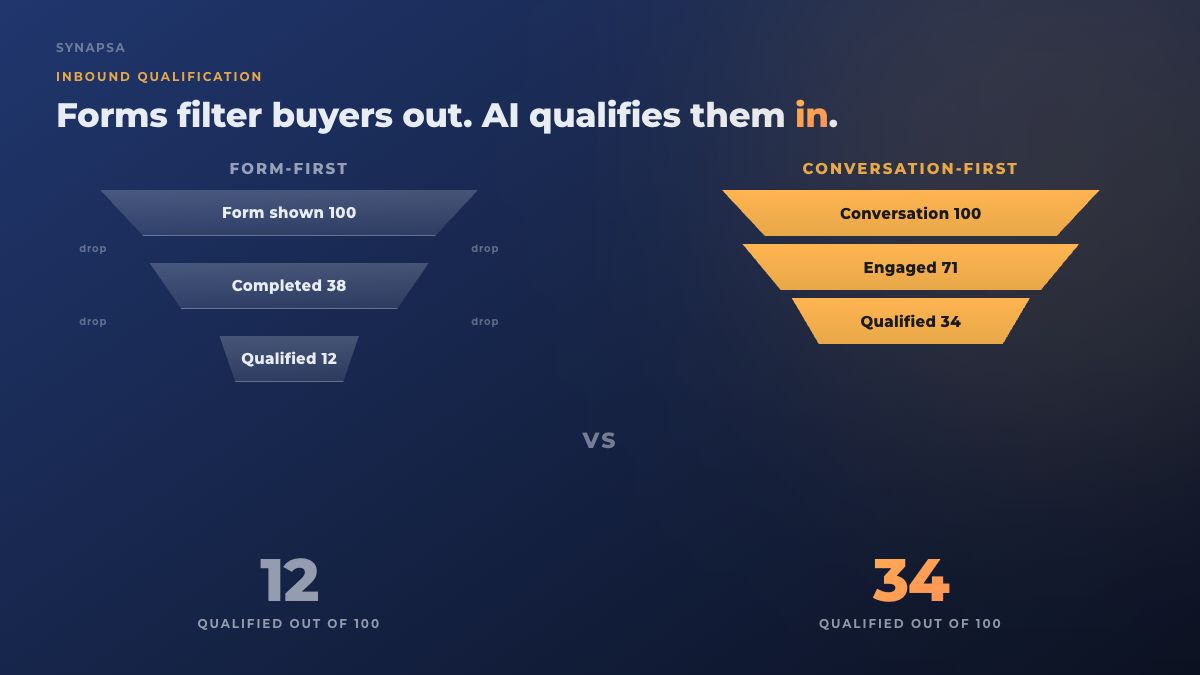
That worked when buyers had patience. Today, most do not. Less than 3 percent of website visitors fill out forms. The other 97 percent leave without a conversation. The form was designed to protect rep time. It also filters out the buyers who are most in-market but least patient. Your highest-intent leads often leave before the form is done.
Here is the part most teams have not measured. The exit rate on your inbound qualification flow is not random. Buyers in late-stage research, ones who already know what they need and are picking between two or three vendors, are the most likely to abandon a long form. They are also the most valuable. The form is filtering them in the wrong direction.
None of this is new. You head-nod because you have lived it. The problem is that for years, the only alternative was a chatbot that asked five canned questions and routed everything to a calendar link. That is not qualification. That is a faster gate.
What changed is that AI agents can now run the same conversation a senior rep would run, at scale, with the same playbook, for every visitor, every time.
How AI Conversation Qualification Works
The mechanism is not complicated. It is the part that no scripted chatbot has ever done well.
An AI qualification agent engages a visitor the moment they show real intent. It runs a guided selling conversation that surfaces their pain, tests for urgency, checks fit against your ICP, and assesses authority and budget. It adapts to what the buyer actually says, not to a decision tree. When the buyer qualifies, it books the meeting. When they do not, it ends the conversation honestly and either nurtures them or moves on.
The agent is trained on your playbook, not a generic script. It knows what your reps would ask in this situation, what your category requires, and what your specific qualification criteria are. The same way you would train a new SDR. The difference is that the training compounds. Every conversation makes the agent better. And the agent runs at 10pm, on a Sunday, in three time zones, with the same depth as your best rep on a Monday morning.
This is what we mean by speed to conversation, not speed to lead. The metric is not how fast you respond. It is how fast you get to a real conversation. The one that removes uncertainty, reduces effort, and opens the path to a real buying decision. More on that reframe here.
The 5-Step AI Qualification Playbook
If you are building an AI qualification motion, these are the five steps that matter. In order.
1. Define your qualification criteria. Pain, urgency, fit, authority, budget. Get specific. Not "is this person a director or above." More like "does this person own a number that this product would move." Generic criteria produce generic conversations.
2. Train the AI on your discovery questions. Hand the agent the same questions your best rep asks on a discovery call. Not a survey. A conversation. The agent should know how to ask, how to probe, and when to move on.
3. Set routing thresholds by tier. Not every qualified buyer goes to the same rep. Define tiers (enterprise, mid-market, SMB, partner) and decide which qualified buyers route where. The agent does the routing, but you set the rules.
4. Layer conversation with forms. Some buyers want to submit a form and book a meeting. Let them. Then run the AI conversation after the form, as a pre-meeting discovery and warmup. Conversion is layers, not either-or.
5. Close the loop post-booking. The conversation should not end at "meeting booked." The agent should send confirmations, handle reschedules, run reminders, and recover no-shows. The qualification work you just did is lost if the meeting never happens. A closed-loop system protects the pipeline you just generated.
Forms and AI Conversation Are Not Either-Or
Most teams ask the wrong version of this question. "Should we replace forms with AI chat?" That is a false binary. Conversion is layers.
Some buyers know what they want. They want to submit their information, book a meeting, and get on with their day. The fastest path is a form. Let them have it.
Other buyers are not convinced. They have a question. They want to understand what your product actually does before they commit to a 30-minute call. The fastest path for them is a conversation. Give them one.
The strongest systems run both, from one stack, with one set of context. A buyer who submits a form should get the AI conversation after the form, as a warmup for the meeting. A buyer who starts a chat should be able to book a meeting inside the same conversation. The form captures the data. The conversation captures the intent. The agent carries the context from one to the other.
This is the part Helium SEO names well. The AI engaged 12,800 website visitors. 188 of them had a real conversation. 8 qualified. 6 booked meetings. The AI de-qualified 90 percent of conversations on its own. Scott Sutter, their Head of Sales, put it bluntly. "It de-qualified 90 percent. That actually for a salesperson saved me 90 percent of my time." The form alone would have caught a fraction of those 188 conversations. The form alone would have qualified none of them with that precision.
How to Measure Whether It Is Working
If you are deploying an AI qualification agent, four numbers tell you whether it is actually working.
AI conversation to qualified meeting rate. What percentage of AI conversations end with a meeting on the calendar. This is the core efficiency of the agent. Strong systems run between 4 and 8 percent. Weak systems run under 1 percent and look like a faster chatbot.
Show rate. What percentage of AI-qualified meetings actually happen. SaaS Academy moved show rates from 40 to 50 percent up to 60 to 70 percent by closing the loop on no-show recovery. The qualification work is wasted if the meeting does not happen.
Sales cycle length. Are AI-qualified meetings closing faster than form-fill leads. Sama saw their AI-qualified pipeline close three times faster than their normal pipeline. Better qualification at the top means less time at the bottom.
Rep time per qualified meeting. Are your reps spending more time on better conversations, or chasing bad ones. This is the qualitative number. Ask your team if their week feels different. Their answer matters more than the dashboard.
Track these before deployment, then again 60 days in. The story is in the deltas, not the absolutes.
The teams that win are the ones who treat qualification as a conversation, not a filter. They use forms where forms work, layer AI conversation everywhere else, and close the loop post-booking. More on how this shifts the entire qualification motion.
FAQ
What is the difference between AI lead scoring and AI lead qualification?
Lead scoring ranks existing leads by likelihood to convert, using historical data and firmographic signals. AI lead qualification is a real-time conversation that discovers whether a buyer has the right pain, urgency, fit, and authority to move forward. Scoring is a data model. Qualification is a conversation. Both have a role. Only one of them can catch a high-intent buyer who just landed on your website.
Can AI really qualify leads as well as a human SDR?
For discovery and initial qualification, yes, and in some ways better. AI agents engage every visitor within seconds, follow your qualification playbook every single time, and never have an off day. Helium SEO's AI agent de-qualified 90 percent of conversations, saving their sales team 90 percent of the time they would have spent on unfit leads. The difference is consistency at scale that humans cannot maintain.
What questions should an AI ask to qualify an inbound lead?
The five dimensions that matter: pain (what specific problem are they trying to solve), urgency (what changes if they do not solve it in the next 90 days), fit (do they match your ICP), authority (can they make or influence the decision), and budget (is there real money allocated). AI qualifies across all five in a natural conversation, not an interrogation.
How do AI chatbots for lead qualification differ from traditional chatbots?
Traditional chatbots follow scripted decision trees. If the visitor says X, respond with Y. When a buyer says something unexpected, the chatbot falls off the script. AI qualification agents adapt to what the buyer actually says, follow the intent of your playbook instead of a branching flowchart, and keep the conversation moving toward a real outcome.
Should we replace our web forms with AI chat for lead qualification?
Do not replace. Layer. Forms serve buyers who want to self-serve and submit their information on their own timeline. AI conversation serves buyers who need a guided interaction before committing to a meeting. The strongest systems run both at the same time and use the AI agent to continue discovery after a form is submitted. The form captures the data. The conversation captures the intent.
How long does it take to set up AI lead qualification?
Setup time depends on how well-defined your qualification criteria are before you start. Teams with a documented ICP and sales playbook are typically live in under a week. The training investment, building the agent's knowledge base and calibrating its discovery questions, is real. It is also a one-time build that runs 24 hours a day without rep time.
What metrics should we track to measure AI qualification performance?
Four signals that matter. One, AI conversation to qualified meeting rate. Two, show rate (what percentage of AI-qualified meetings actually happen). Three, sales cycle length (are AI-qualified meetings closing faster). Four, rep time per qualified meeting. Track these before and after deployment. The story shows up in the deltas.
How does AI lead qualification work for buyers who come in after hours?
AI agents run 24 hours a day with no coverage gap. A buyer who starts a chat at 10pm gets qualified in real time, not the next business day. Momentum's VP of GTM reported that AI qualification running at 10pm, with the same quality as business hours, was a critical part of taking their website conversion rate from 0.2 percent to 2 to 3 percent.