“I was really skeptical about this and I did not think it was gonna go well but in the first 30 days, I believe we hit over 75 meetings.”


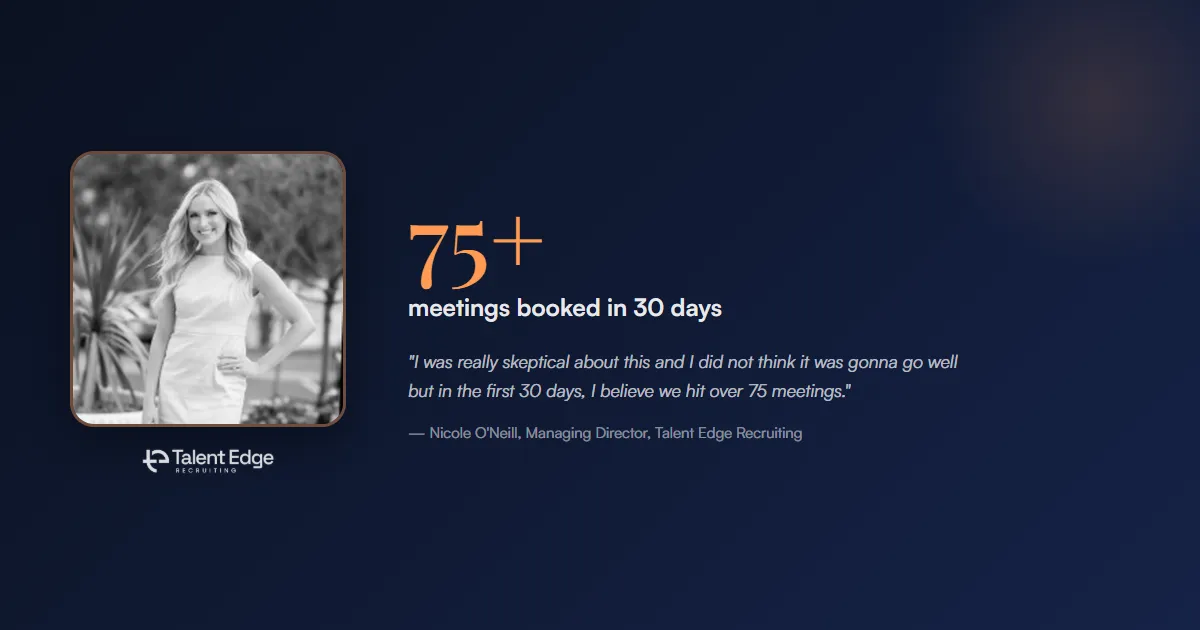
Nicole O'Neill has spent her career building national recruiting businesses on one principle: whoever responds first wins. Talent Edge Recruiting operates across all 50 states, specializes across every industry and skill set, and wins by moving faster than every other firm in the market. The irony was that as their outbound started working, their inbound started breaking. Good messaging was generating interest. The team couldn't keep up.
When Fast Isn't Fast Enough
At nationwide scale, 500 cold calls in two hours isn't a lot. When Talent Edge's outreach started producing a flood of interested prospects, the small BD team — a few account managers and assistants — hit the problem every growing firm eventually faces: leads coming in faster than any human team could handle.
Three specific failure modes were costing them business:
- Missed leads. Without a reliable CRM, prospects were falling through the cracks entirely — never followed up on, never converted.
- Delayed responses. Leads that came in overnight, across time zones, or on weekends waited until someone got back to them. In recruiting, that delay hands the meeting to whoever responded first.
- Forgotten calendar invites. A prospect would get booked and the Teams invite never went out. The meeting would never happen.
"When it comes to prospective business and leads, you need to get in front of them right away or they'll go to your competition that answered faster than you did. Everyone does that. When I was looking for life insurance quotes, whoever answered me fastest is who I went with."
— Nicole O'Neill, Managing Director, Talent Edge Recruiting
They were generating the demand. The conversion layer was breaking. Nicole knew she needed a system that could respond immediately, around the clock, without the errors that came with asking a small team to touch hundreds of prospects every month.
The Failed AI Attempt
Nicole didn't walk into Synapsa with open arms. She'd already tried another AI solution and gotten burned.
The first platform looked promising in demos. But once deployed, the AI started answering leads incorrectly — misrepresenting what Talent Edge did, giving confident answers about services they didn't offer. When you're a recruiting firm selling trust, having an AI agent say the wrong things doesn't just lose leads. It requires damage control. Campaigns had to pause. Relationships had to be repaired.
"It cost us some leads. And it kind of put us back a little bit because now we have to do damage control, fix the leads that it was saying crazy things to."
— Nicole O'Neill
She was ready to declare AI not ready for her industry and hire another person instead. Then something made her search one more time.
What Made Synapsa Different
When Nicole found Synapsa — through a ChatGPT search for better options — she was still skeptical. Three things changed her mind.
She could train the AI herself. Synapsa's knowledge base gave her direct access to define who Talent Edge is, how they work, and exactly how the AI should respond. She could test responses in real time, see if anything felt off, and fix it immediately. No opaque backend. No waiting for the system to "learn." She was in control from day one.
"We were able to train the AI ourselves. It's like training your own sales rep. We were able to teach it everything that we do and how to respond to certain scenarios."
— Nicole O'Neill
The AI actually books the meeting. Not "here's a link, go figure it out." Synapsa integrated directly with Microsoft Teams and Outlook, sending calendar invites with meeting links automatically — the specific thing the previous platform couldn't do. For a team losing meetings to forgotten invites, this was material.
The full follow-up lifecycle was built in. If a prospect didn't accept the invite, the AI followed up. If someone canceled, the AI automatically reached out to reschedule. These had all been manual tasks eating her team's time. They stopped being tasks.
"I've been working with Synapsa now almost six months, so I kind of forget all the things that I used to manually do that the system does now, because I've gotten so used to it."
— Nicole O'Neill
The Results
Nicole went into launch expecting to be disappointed. Instead, the meetings started coming in before she'd adjusted her expectations.
- 10 meetings booked in week one
- 75+ meetings in the first 30 days
- 199+ total meetings booked to date
- Had to pause outreach campaigns because meeting volume overwhelmed the team's capacity
- Hired two new team members to handle the increased client load
"I was really skeptical about this and I did not think it was gonna go well but in the first 30 days, I believe we hit over 75 meetings. It got to a point where we literally needed to pause our outreach because we had so many meetings booked."
— Nicole O'Neill
The scale forced a staffing change — not because the team was failing, but because the system was producing more opportunity than the existing headcount could absorb. That is a different kind of problem.
"It's a positive domino effect. As more meetings are getting booked, I have to hire more, more clients we're working with, more roles for my recruiters — the more revenue and business is generated. So it was this positive domino effect that happened because Synapsa works so well, right? Literally right away."
— Nicole O'Neill
A New Team Member
Six months in, Nicole describes the Synapsa AI not as a tool, but as a colleague.
"We gave our AI a name and reference it by its name — it really is like another team member for us."
— Nicole O'Neill
That framing matters. The AI learned Talent Edge's voice, incorporated their values, and now represents the brand in every first conversation with a prospect. Nicole doesn't worry about leads coming in overnight or across time zones. She doesn't worry about calendar invites going unsent or about a prospect going to a competitor because nobody answered in time. The AI handled it.
She's also quick to note the boundaries. The AI is not replacing her recruiters or account managers. It's handling the assistant-level work — the immediate response, the scheduling, the follow-up logistics — so her human team can focus on the relationships that require a human.
"The AI was trained in a day, which is pretty much impossible to train a human in a day."
— Nicole O'Neill
Key Takeaways for Recruiting Leaders
- Speed-to-lead is a competitive filter, not a metric. In a market where every firm competes for the same talent and clients, the firm that responds first wins the meeting. That gap widens at national scale, where time zones and overnight leads are structural problems humans can't solve alone.
- Control over training is non-negotiable. The ability to test, refine, and own what the AI says is the difference between an asset and a liability. A black-box AI in a relationship-driven industry isn't AI adoption — it's risk that shows up in your pipeline.
- Automation doesn't replace relationships — it protects them. Talent Edge didn't replace account managers. The AI handles the response, the booking, the follow-up, and the rescheduling so the humans can focus on the conversations that actually require a human touch.
- Volume creates hiring velocity. When the inbound response system works at scale, the pipeline expands faster than existing headcount can absorb. That's a good problem — but you need to be ready for it. Nicole hired twice because the system kept delivering.
- The first conversation sets the tone. For Talent Edge, the AI now represents the brand in every first touchpoint with a prospect. Getting that right means the relationship starts right — and the client's first impression of how quickly and professionally Talent Edge moves is exactly the impression they intended.